

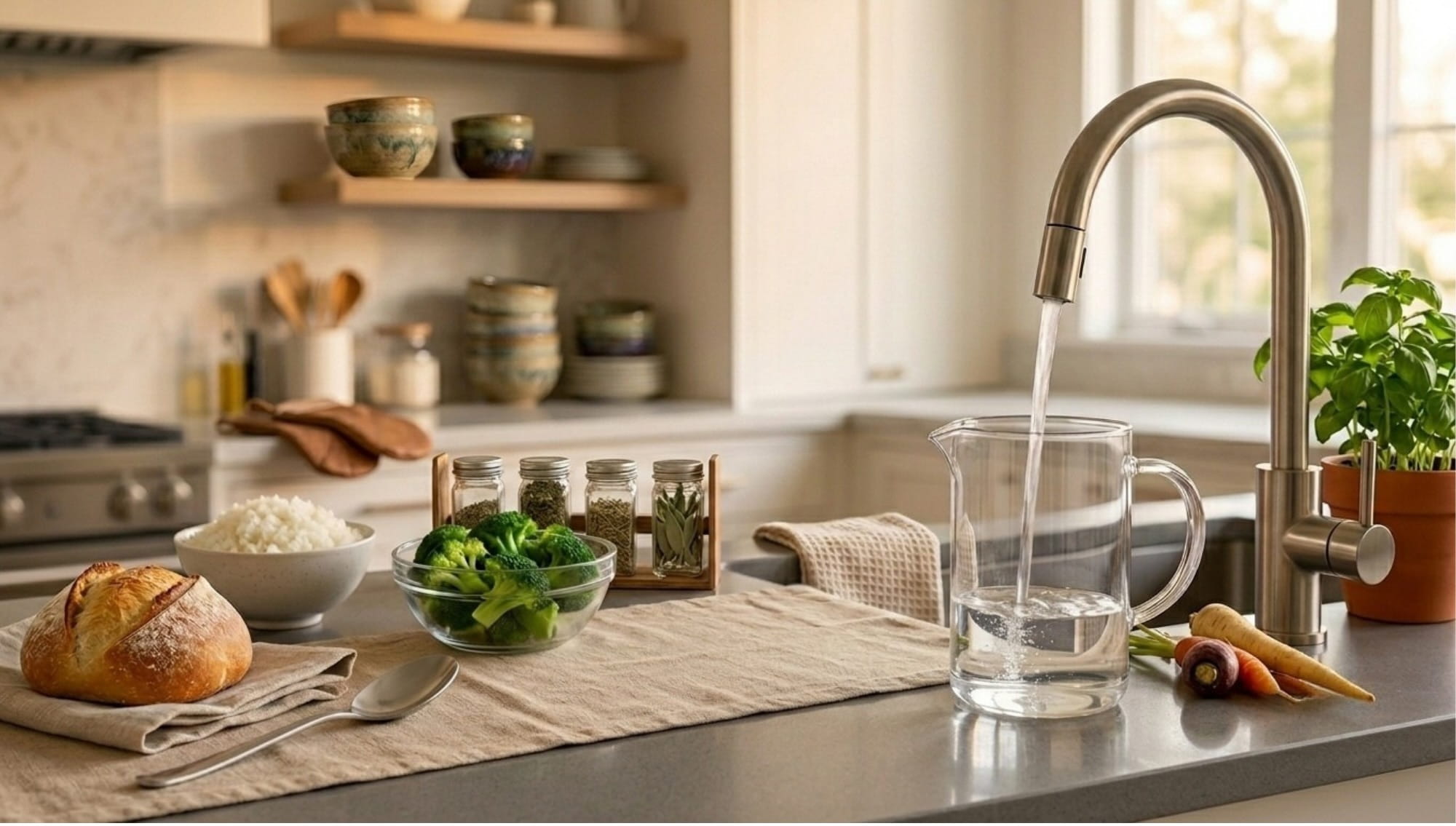
When we think about elevating our culinary creations, we often focus on sourcing the finest ingredients. We hunt for organic, locally grown vegetables, splurge on high-grade unbleached flour, and select prime cuts of meat. Yet, we frequently overlook the single largest ingredient by volume in our kitchens: water.
Whether you are boiling pasta, simmering a bone broth, or feeding a delicate sourdough starter, water is not just a passive medium—it is an active chemical ingredient. Municipal tap water, while generally safe to drink, carries residual disinfectants, heavy metals, dissolved solids, and varying pH levels that silently alter the chemistry of your recipes.
If you have ever wondered why your home-baked bread doesn’t rise quite like the bakery's, or why your homemade stocks look cloudy, the culprit might be flowing right from your kitchen faucet. Here is a science-backed look at how upgrading to a Reverse Osmosis (RO) water system fundamentally transforms and upgrades your cooking and baking.
1. It Protects Your Sourdough and Yeast Fermentation
For bakers, fermentation is everything. The magic of an airy, open-crumb loaf of bread relies entirely on living microorganisms: yeast and beneficial bacteria. This is precisely where tap water presents an invisible hurdle.
The Science
To ensure public safety, municipal water treatment facilities add disinfectants like chlorine and chloramine. These chemicals are incredibly effective at killing harmful bacteria and pathogens in the water supply. However, they do not differentiate between harmful pathogens and the beneficial microbes in your dough.
While commercial quick-rise yeast is highly concentrated and can often tolerate low levels of chlorine, wild yeast and lactobacilli in artisan sourdough starters are exceptionally sensitive. Residual chlorine can slow down, stunt, or completely halt the fermentation process. Furthermore, when chlorine interacts with phenols in the flour, it can produce subtle, medicinal off-flavors (chlorophenols) in the finished bread.
The RO Benefit
A reverse osmosis system utilizes a multi-stage filtration process, including high-capacity carbon blocks that remove up to 99% of chlorine and chloramine. By cooking and baking with RO water, you provide a clean, chemical-free environment where your yeast can thrive naturally. The result? A more reliable, robust rise, a predictable fermentation schedule, and a clean, complex flavor profile untainted by municipal chemical residues.
2. It Improves the Texture of Rice, Grains, and Beans
Achieving the perfect texture in starchy staples—grains that are fluffy and distinct rather than mushy, or beans that are tender rather than chalky—is a balance of temperature, time, and water chemistry.
The Science
The primary issue here is water hardness, determined by high concentrations of dissolved calcium and magnesium ions. When you cook grains (like rice or quinoa) or legumes (like dried beans) in hard tap water, these divalent metal ions interact with the starches and proteins on the food's surface.
Specifically, calcium ions bind with pectin in the cell walls of beans and the starches in rice, forming a tight, cross-linked microscopic barrier. This cross-linking reinforces the plant's cell walls and starches, making them highly resistant to breaking down. As a result, water cannot efficiently or uniformly penetrate the core of the food. This leads to uneven cooking—where the outside of the grain or bean becomes mushy before the inside can fully soften—and often requires significantly extended cooking times.
The RO Benefit
Reverse osmosis membranes excel at stripping away over 95% of dissolved inorganic minerals, effectively softening the water without introducing sodium (as traditional salt-based water softeners do). Without excess calcium and magnesium to bind the starches, pure RO water penetrates grains and legumes rapidly and uniformly. Your rice cooks up beautifully plump, light, and fluffy, and your dried beans soften consistently without requiring hours of extra boiling.
3. It Yields Crystal-Clear Broths and Richer Stocks
A hallmark of professional culinary technique is a beautifully translucent, clean-tasting stock or consommé. If your homemade chicken or beef stocks frequently turn out muddy, dark, or gritty, your water's mineral content is likely to blame.
The Science
When hard municipal water is subjected to prolonged boiling, temporary hardness undergoes a chemical reaction. Soluble calcium bicarbonate breaks down, releasing carbon dioxide and leaving behind insoluble calcium carbonate—the micro-sediments we commonly recognize as white scale or soap scum.
In a simmering pot of stock, these microscopic mineral particulates do not simply settle at the bottom. Instead, they act as a coagulant, binding with the floating proteins, denatured collagens, and rendered fats extracted from the meat and bones. This chemical binding creates a suspended colloidal suspension that turns the liquid murky and opaque. Additionally, heavy metals sometimes found in tap water, such as iron or copper, can oxidize during long simmers, causing the stock to take on a gray or unnaturally dull hue.
The RO Benefit
Simmering your stocks with RO water eliminates these interfering mineral precipitates entirely. Because RO water is virtually free of dissolved solids, it acts as a "hungry" solvent, possessing an enhanced capacity to efficiently dissolve and extract the natural, savory glutamates, gelatin, and aromatics from your ingredients. Your broths will remain beautifully clear and jewel-toned, allowing the pure, unadulterated flavors of your ingredients to take center stage.
4. It Preserves the Vibrant Color of Green Vegetables
We eat with our eyes first, and nothing kills the visual appeal of a home-cooked meal faster than bright green vegetables turning a dull, muddy olive-brown during cooking.
The Science
The vibrant green color of vegetables like broccoli, asparagus, green beans, and spinach comes from chlorophyll. Chlorophyll is highly sensitive to its chemical environment, particularly to pH levels (acidity/alkalinity) and the presence of oxidants.
Municipal tap water is systematically treated to be slightly alkaline (often a pH of 7.8 to 8.5) to prevent heavy metals from leaching out of city pipes into the water supply. However, an alkaline environment, combined with residual dissolved chlorine, accelerates a chemical process called deprotonation and the subsequent displacement of magnesium in the chlorophyll molecule. This transforms bright green chlorophyll into a compound called pheophytin, which possesses a distinct olive-brown hue. Furthermore, alkaline water softens plant pectins too quickly, which can make the vegetables mushy before they are fully cooked.
The RO Benefit
The reverse osmosis filtration process naturally yields water that sits at a neutral to slightly acidic pH level (typically 6.5 to 7.0) due to the removal of alkaline minerals and the natural absorption of ambient carbon dioxide. Cooking, blanching, or steaming your green vegetables in chlorine-free, neutral-to-soft RO water minimizes the chemical degradation of chlorophyll. Your vegetables will retain their bright, appetizing, restaurant-quality green color and maintain a crisp, tender texture.
5. It Eliminates Limescale and Extends Kitchen Appliance Lifespan
Beyond the food itself, water quality plays a massive financial and functional role in the health of your kitchen infrastructure. Modern kitchens rely on a variety of high-end, water-utilizing appliances that are highly vulnerable to water chemistry.
The Science
Every time hard tap water is heated inside an appliance, dissolved calcium and magnesium precipitate out of the solution and solidify onto the nearest hot surface. Over time, this forms a rock-hard layer of limescale.
Limescale is an excellent thermal insulator. When it coats the heating elements of an espresso machine, a combi-steam oven, a sous-vide precision cooker, a pressure cooker, or a high-end electric kettle, the appliance must work significantly harder and run hotter to heat the same amount of water. This drastically reduces thermal efficiency, drives up energy consumption, and eventually causes the heating elements to overheat and burn out prematurely. Furthermore, scale buildup can clog internal valves and sensors, leading to costly repair bills or total appliance failure.
The RO Benefit
By routing reverse osmosis water to your countertop appliances and built-in systems, you eliminate the source of scale altogether. Without calcium and magnesium entering the machines, limescale cannot form. Your espresso machines will pull consistent shots at precise temperatures, your steam ovens will run flawlessly, and your appliances will maintain peak energy efficiency—saving you hundreds of dollars in premature replacements and maintenance.
Conclusion: The Ultimate Kitchen Upgrade
When we evaluate our kitchen tools, we easily justify investing in heavy cast iron cookware, professional chefs' knives, and high-performance blenders. Yet, none of these tools interact with your food as intimately or as frequently as water.
Water is the foundation of culinary chemistry. Moving away from unpredictable municipal tap water and adopting reverse osmosis water is one of the simplest, most effective ways to instantly elevate the flavor, texture, appearance, and consistency of everything you create in your kitchen.
Ready to taste the difference that pure water can make? Explore our advanced range of compact, under-sink reverse osmosis systems engineered to bring chef-quality water right to your kitchen faucet.


