

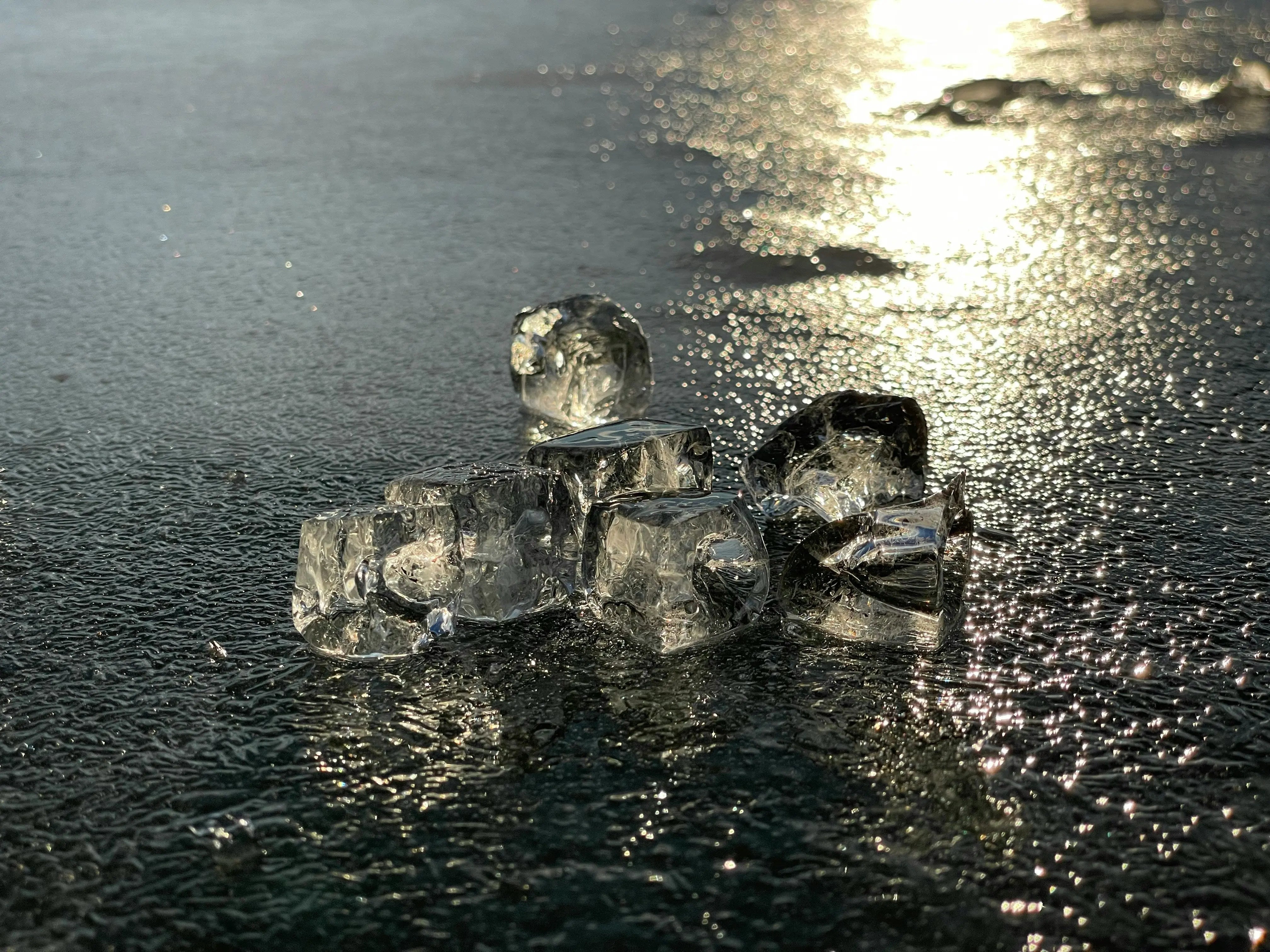
If you’ve ever enjoyed a drink at a modern bar or restaurant, you’ve likely noticed how their ice cubes look crystal clear. They look glassy, dense, and almost perfectly transparent. But at home, even if you use a premium reverse osmosis (RO) water filtration system, the RO ice cubes from your freezer often look cloudy, white, or milky, especially in the center.
Many people assume cloudy ice must mean the water isn’t clean enough or that something is wrong with their RO system. That is not true! Here is what’s actually happening.
1. Why Restaurant & Bar Ice Is Crystal Clear
Restaurants pay close attention to how their ice looks because ice plays an important role in the drinking experience. To achieve transparency, commercial ice machines use a freezing method that gives the ice time to form slowly and evenly. This helps create fewer trapped air bubbles and fewer crystal imperfections.
-
How Crystal Clear Ice is Produced
Commercial ice makers use a process called directional freezing. Water freezes from one side to the other while the rest of the water stays liquid for a longer time. This allows dissolved air to escape before it gets trapped inside the ice. The machine also circulates fresh water during freezing. As ice forms, warmer water with air and tiny impurities flows away. Only the pure, coldest layer stays behind and becomes clear ice. This controlled process is very different from how RO ice forms at home.
As a result, the ice forms in layers that are dense and uniform. There are very few pockets of air. Light passes through the ice without scattering, which makes the cube look transparent.
-
Why They Find It Worthwhile To Do This
Clear ice is not only beautiful. It has practical benefits too. It melts more slowly because it has fewer air gaps. This helps drinks stay cold without getting watered down. Clear ice also has a smooth surface, which makes it pleasant to hold and pleasant to sip around. In cocktail bars, clear ice signals quality. Guests expect premium drinks to come with premium ice.
2. Why Your Home Made Ice Looks Cloudy
Home freezers do not work like commercial ice machines. They are designed to freeze food quickly, not to make clear ice. The way a freezer circulates cold air has a direct impact on how ice freezes.
At home, water freezes from every direction at the same time. The top, bottom, and sides get cold together. This traps air inside the ice before it has time to escape. When light hits these tiny air bubbles, it scatters in many directions. This scattering makes the ice appear white or cloudy.
Factors in your freezer that make ice more cloudy:
-
Rapid freezing: When freezing happens too fast, the water cannot push air outward. The air becomes trapped inside the cube.
-
Temperature swings: Opening the freezer door often can cause slight changes in freezer temperature. This can interrupt the freezing process and cause more uneven ice.
-
Freezer airflow: Cold air moves around the freezer unevenly. Air currents may freeze some sides of the tray faster than others.
-
Ice tray material: Thin plastic trays freeze from every side at once. They do not control temperature or freezing direction.
All of these conditions make it inherently difficult to create clear ice in a typical home freezer. It’s not that the water is “dirty”. The real challenge is that home freezers cannot control how water freezes. Without directional freezing or controlled water flow, dissolved air and microbubbles have nowhere to go and end up trapped inside the ice.
3. Why RO Ice May Also Become Cloudy
RO water is widely recognized for being exceptionally pure, so why can RO ice still turn cloudy? In home freezers, most cloudiness comes from trapped air rather than dissolved solids. And when we talk about “purity” here, we mean that RO water contains very few dissolved minerals or other impurities. However, RO ice can still appear cloudy because very pure water may freeze in a way that makes air more likely to get trapped during the freezing process:
-
Faster Ice Crystal Growth
With almost no minerals, RO water can freeze more quickly and uniformly. Rapid crystal growth traps dissolved air before it can escape.
-
More Uniform Freezing Once It Begins
RO water has little impurities to disrupt the freezing process. When it hits the freezing point, it tends to freeze all at once from every direction, and lock air into the center.
-
No Natural Nucleation Points to Disperse Air
Tap water contains tiny particles that help spread bubbles throughout the ice. RO water is so pure that trapped air collects in one concentrated cloudy spot.
These factors combined can explain why RO ice can sometimes appear cloudy under typical home freezer conditions. It is not because the water quality is worse, but because purity changes how water freezes.
4. How to Make Crystal Clear Ice at Home
These techniques below are especially helpful for improving the clarity of RO ice, which tends to freeze too quickly in a standard home freezer. By slowing the freezing process and controlling the direction of freezing, you can create clear ice at home without any special equipment.
-
Use directional freezing
One of the easiest methods is to use a small insulated cooler. Fill it with RO water and place it in the freezer without the lid. Because the cooler sides are insulated, only the top freezes first. Ice forms slowly downward. Air and impurities collect at the bottom. Once fully frozen, remove the block, cut off the cloudy bottom layer, and cut the clear top section into cubes.
-
Try a clear ice mold
Some ice molds are designed with insulated walls. These molds slow the freezing process and guide the freezing direction. They can produce clear cubes with little effort.
-
Boil the water first
Boiling helps reduce some dissolved air. Let the water cool before freezing. Boiling alone will not make perfect clear ice, but it can reduce cloudiness.
-
Lower the freezer temperature
A colder freezer makes ice form more slowly. Slow freezing gives gases time to escape.
-
Avoid vibration and disturbance
If the ice tray moves or shakes during freezing, tiny bubbles can get trapped more easily.
With these methods, you can create ice at home that looks much closer to what you see in restaurants. It may take a bit more time, but the results are worth it if you enjoy drinks with a clean, polished look.
Final Thoughts
Clear ice is mostly a result of controlled freezing, not water purity. Restaurants achieve this with advanced ice makers that freeze water slowly and in one direction. Home freezers cannot replicate this environment, so ice often turns cloudy. Even RO ice can be cloudy due to trapped air.
By understanding how ice forms, you can use simple methods to improve clarity at home. With slower freezing, better control, and a little patience, you can enjoy crystal clear cubes that melt slowly and look beautiful in any drink.