

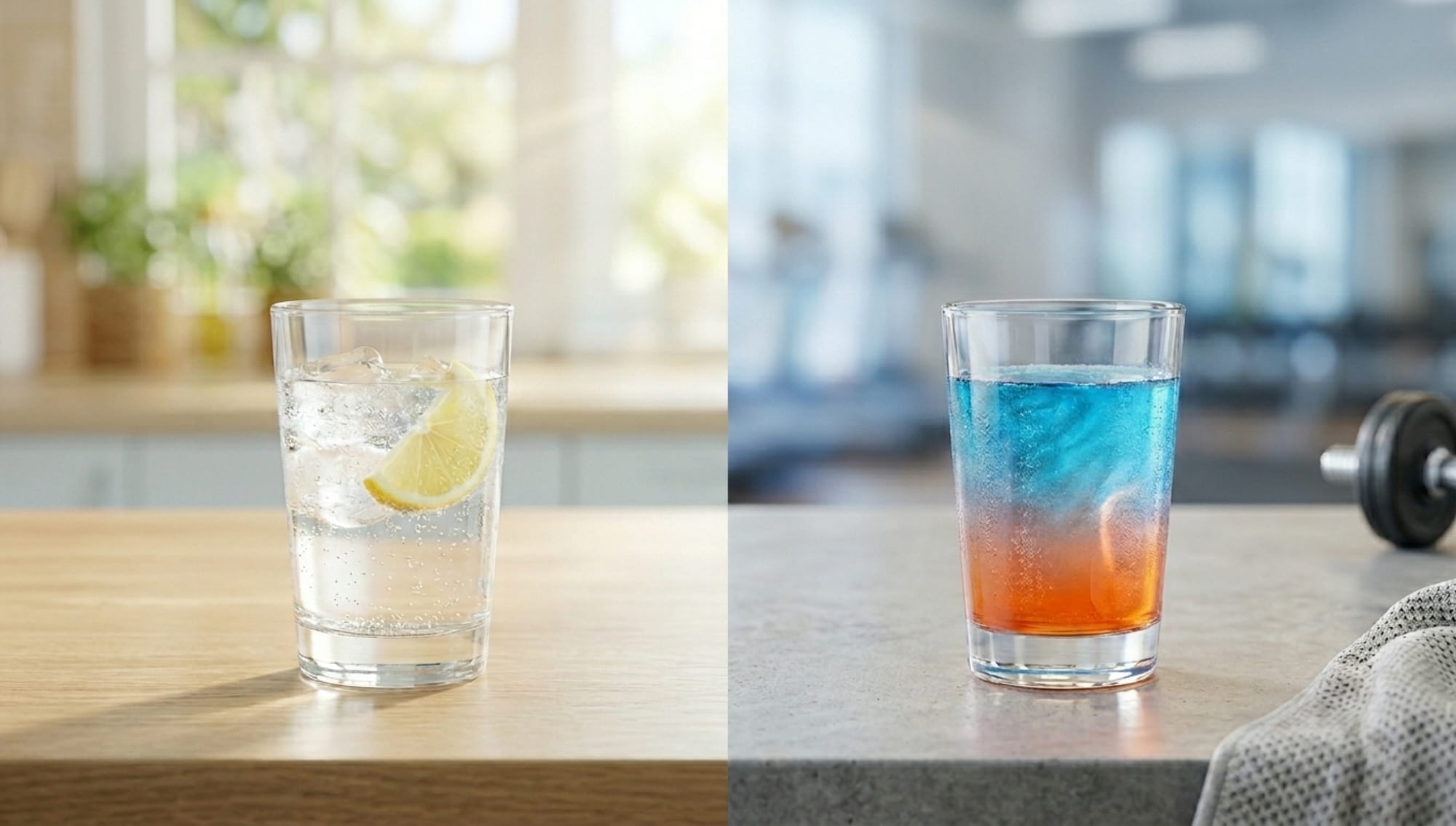
When you’re thirsty after a long day or a hard workout, the choice usually comes down to two options: a bottle of plain water or a sports drink. Water is natural and free, while sports drinks are specifically formulated with electrolytes and flavors to help with recovery.
Choosing the "best" one depends entirely on what your body has been doing for the last hour. Hydration is not simply drinking enough fluid, it’s actually about fluid balance—maintaining the right ratio of water to minerals in your blood. Sometimes water is exactly what you need, but in specific situations, those extra ingredients in a sports drink actually serve a functional purpose.
In this guide, we’ll look at the science behind both to help you decide which one is more effective for your current lifestyle and activity level.
1. When Water Is Your Best Option
There is a reason why water is the default recommendation for health. It is the most natural, accessible, and cost-effective way to keep your body running. From a physiological standpoint, water is a "clean" fuel.
Why Water Wins
Water handles the heavy lifting for your internal organs. It aids kidney function by flushing out waste, keeps your skin elastic, and lubricates your joints. Perhaps its biggest advantage over sports drinks is that it has zero metabolic cost. When you drink water, your body doesn't have to process sugars or artificial dyes. There is no insulin spike and no extra calories to burn off later.
When Water is Enough
For the vast majority of people, water is all you need. If your day consists of:
-
Sedentary office work or running light errands.
-
Low-intensity movement like a 30-minute walk or a yoga session.
-
Short-duration workouts that last less than 45–60 minutes in a cool environment.
In these scenarios, your body isn't losing enough minerals through sweat to justify the added sugars and salts found in sports drinks.
The Limitation: The Risk of Over-hydration
It sounds counterintuitive, but you can actually drink too much water. This leads to a dangerous condition called hyponatremia. This happens when you sweat heavily (losing salt) but only replace it with plain water. You end up diluting the sodium levels in your blood to a point where your cells start to swell. For high-intensity athletes, relying solely on water can actually be counterproductive, and in extreme cases, life-threatening.
2. What’s Actually Inside a Sports Drink?
If water is the baseline, sports drinks are the "enhanced" version designed for specific stress. To understand why they work, we have to look at the anatomy of the bottle.
1. Electrolytes
Electrolytes are minerals like sodium, potassium, and magnesium. They carry an electrical charge that allows your brain to communicate with your muscles. Without enough sodium, your muscles can’t contract properly, which leads to the dreaded "exercise cramps".
2. Carbohydrates
Most sports drinks contain a 6–8% carbohydrate solution (sugar). While we often view sugar as "bad", in the context of intense exercise, it serves a dual purpose. First, it provides a quick energy source to prevent glycogen depletion (hitting the wall). Second, and more importantly for hydration, it helps water cross the gut barrier faster.
3. The "Sodium Pull" Science
This is the "secret sauce" of sports drinks. Our bodies use a mechanism called the Sodium-Glucose Co-transport. Essentially, water likes to follow salt and sugar. When sodium and glucose enter your small intestine, they act like a magnet, "pulling" water molecules through the intestinal wall and into your bloodstream much faster than plain water could move on its own. This makes sports drinks isotonic, meaning they match the concentration of your blood for rapid absorption.
3. When Should You Reach for a Sports Drink?
A sports drink is a tool, not a casual beverage. You should reach for one when your physical demands exceed your body's baseline storage.
The 60-Minute Rule
As a general rule of thumb, if you are exercising at a high intensity for more than 60 to 90 minutes, water alone will likely fail you. At this point, your body’s stored glucose (glycogen) is running low, and your electrolyte levels are dropping.
Are You a "Salty Sweater"?
Have you ever noticed white streaks on your gym clothes or felt a gritty, salty texture on your skin after a run? This means you are a "salty sweater". You lose more sodium than the average person, making you a prime candidate for a sports drink even during shorter, intense sessions.
Environmental Factors
Temperature matters. If it is over 30°C (86°F) or high humidity, your body works twice as hard to cool down through evaporation. In these conditions, you aren't just losing water; you are losing the minerals that keep your heart and muscles stable.
Illness and Recovery
Sports drinks aren't just for athletes. During a stomach flu or heat exhaustion, your body loses fluids and salts rapidly. In these moments, a sports drink (or an oral rehydration solution) is often more effective at settling the system and restoring balance than plain water.
4. The "Sugar Trap" and Other Downsides
Despite their benefits, sports drinks have a down side, which is mostly because they are marketed to people who don't actually need them.
-
Caloric Density: A typical 20oz bottle can contain 30–35 grams of sugar and 150 calories. If you just did a 30-minute jog to burn 200 calories, drinking a sports drink immediately afterward undoes most of your hard work.
-
Dental Health: Most sports drinks are highly acidic. When you sip them slowly over an hour-long workout, you are essentially bathing your teeth in acid and sugar, which can lead to rapid enamel erosion.
-
The Marketing Trap: Be wary of "Vitamin Waters" or "Hydration Teas". Many of these are just flavored sugar water with minimal electrolyte benefits. They are lifestyle products, not performance tools.
5. DIY Hydration: Making Your Own at Home
If you want the benefits of a sports drink without the neon food coloring and high price tag, you can make a "natural" version in your kitchen. This is perfect for "casual athletes" who need a bit more than water but don't want a sugar bomb.
The Kitchen Formula:
-
1 Liter of Water (The base)
-
1/4 teaspoon of Sea Salt (For sodium)
-
Juice of 1 Lemon or Lime (For potassium and flavor)
-
1 to 2 teaspoons of Honey or Maple Syrup (For glucose to aid absorption)
This homemade version provides the necessary "sodium pull" for absorption without the artificial additives.
6. Match Your Drink to Your Sweat
So, which is more effective? The answer depends entirely on your activity.
-
Choose Water for your daily life, your office hours, and your moderate gym sessions. It is better for your weight, your teeth, and your wallet.
-
Choose Sports Drinks when you are pushing your limits—long runs, competitive sports, or working in extreme heat. They are a functional tool for recovery and performance.
At the end of the day, hydration isn't about the brand on the bottle, it's about listening to your body's needs. If you're sweating buckets, give it some salt and sugar. If you're just thirsty, stick to the tap.


