

With growing awareness around water quality, “forever chemicals”(PFAS) are making headlines worldwide. Following milestone federal actions and ongoing regulatory debates over nationwide drinking water limits, public concern is at an all-time high. Recent updates from the U.S. Environmental Protection Agency (EPA) have kept the spotlight firmly on municipal water safety, leaving millions of Americans wondering just how safe their tap water actually is.
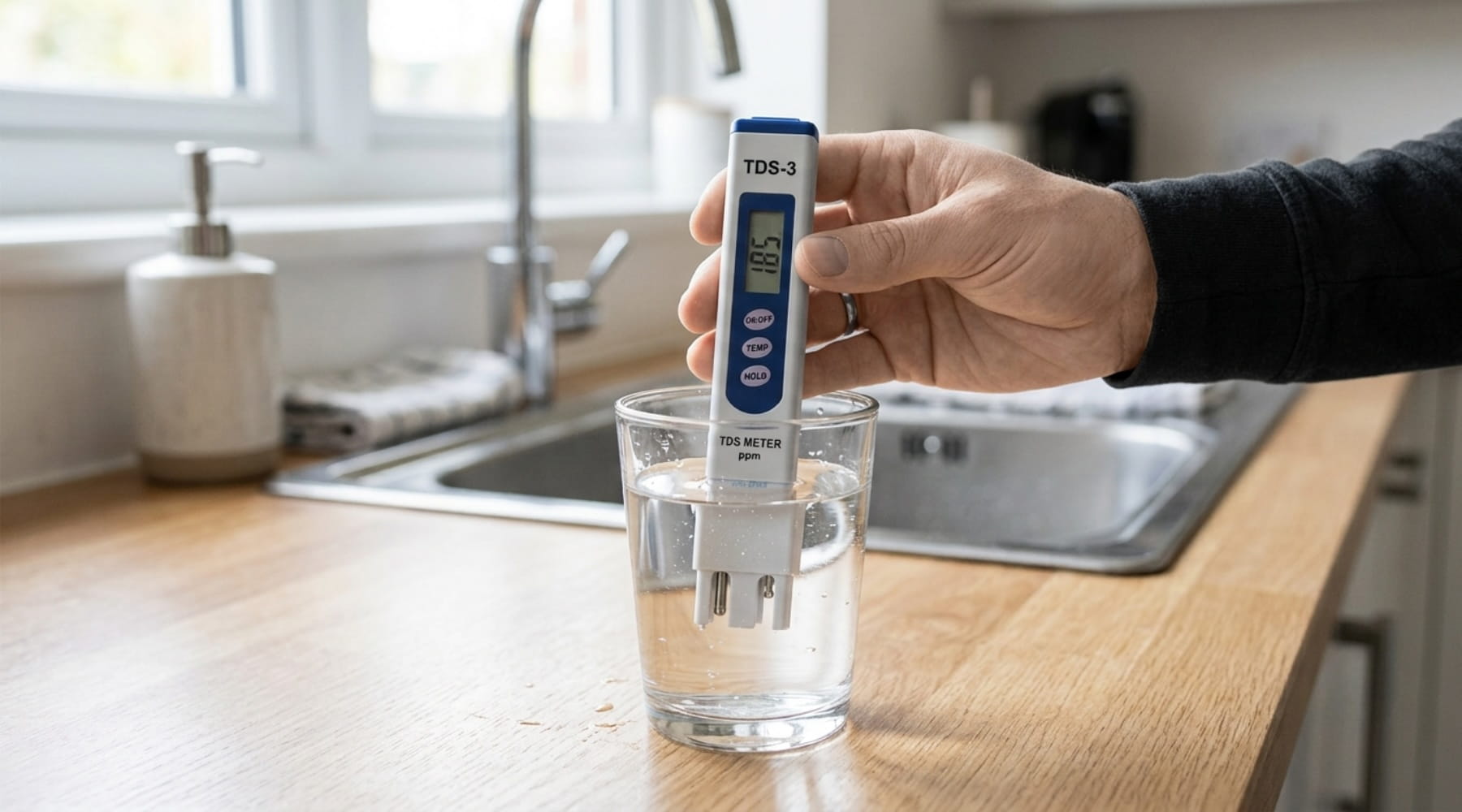
As a result, many homeowners are pulling out their trusty digital water testers to check their tap water. If you own a Total Dissolved Solids (TDS) meter, you might be wondering: Can a TDS meter test for PFAS?
The short answer is no. A standard home TDS meter cannot detect the presence of PFAS in your drinking water. To understand why and to learn how you can actually test for and remove these contaminants, we need to look at the science behind how these tools work and the unique nature of forever chemicals.
What Does a TDS Meter Actually Measure?
To understand why a TDS meter fails at finding PFAS, it helps to know what it’s actually looking for.
TDS stands for Total Dissolved Solids. A TDS meter is a simple, highly effective tool designed to measure the total concentration of dissolved inorganic salts and minerals in your water. This includes things like:
-
Calcium and magnesium (which cause hard water)
-
Sodium and potassium
-
Chlorides and sulfates
How it works: A TDS meter doesn’t actually "see" individual chemicals. Instead, it measures the electrical conductivity of the water. Because minerals and salts are made of charged ions, they conduct electricity. The meter reads this conductivity and converts it into a parts-per-million (ppm) reading.
If your water has a lot of dissolved minerals, it conducts electricity well, resulting in a higher TDS reading. If you use a high-quality under sink water purifier like a reverse osmosis system, the minerals are stripped away, the conductivity drops, and your TDS meter reads near zero.
What Are PFAS and Why Do They Slip Past TDS Meters?
PFAS are a vast group of synthetic chemicals used since the 1940s in non-stick cookware, stain-resistant fabrics, firefighting foams, and food packaging. They earn the nickname "forever chemicals" because their carbon-fluorine bonds are some of the strongest in nature, meaning they do not break down easily in the environment or in the human body.
There are two primary scientific reasons your home TDS meter is completely blind to PFAS:
1. The Chemistry of Conductivity
Unlike calcium or sodium, PFAS are primarily organic compounds. While they do have a slight charge, they do not impact the electrical conductivity of water in a way that a basic consumer meter can register. You could have a dangerous amount of PFAS in your tap water, and the TDS meter would still read a perfectly normal number.
2. The Problem of Scale: Parts Per Million vs. Parts Per Trillion
This is the biggest hurdle. A TDS meter measures in parts per million (ppm).
Because PFAS are incredibly toxic even in microscopic amounts, the EPA’s new maximum contaminant levels for chemicals like PFOA and PFOS are set at just 4.0 parts per trillion (ppt).
To put that scale into perspective:
-
One part per million (ppm) is roughly one drop of water in a 13-gallon gas tank.
-
One part per trillion (ppt) is roughly one drop of water in 20 Olympic-sized swimming pools.
Expecting a consumer TDS meter to find forever chemicals is like trying to measure the width of a human hair using a highway mileage marker. The tool simply isn't built for that level of microscopic precision.
How Can You Actually Test Your Water for PFAS?
If you want to know with absolute certainty whether forever chemicals are flowing out of your kitchen faucet, you cannot rely on DIY at-home testing kits or digital pens.
You need to send a water sample to a certified, independent laboratory. These labs use highly advanced equipment, specifically liquid chromatography-tandem mass spectrometry (LC-MS/MS), following strict EPA testing protocols like EPA Method 533 or 537.1.
While lab testing provides accurate data, it can be expensive. Because PFAS contamination is so widespread in municipal water tables, many homeowners choose to skip the expensive testing phase and directly invest that money into a comprehensive home water filtration system capable of removing the threat entirely.
How to Remove PFAS from Your Drinking Water
Not all water filters are created equal. Standard carbon-pitcher filters can improve taste and remove chlorine, but independent studies and Water Quality Association (WQA) guidelines indicate they often struggle to capture the full spectrum of forever chemicals.
If you are looking to secure your home's water supply, the most scientifically proven and widely recommended technology for PFAS removal is Reverse Osmosis (RO).
Reverse osmosis forces water through a semi-permeable membrane with pores so incredibly small (down to 0.0001 microns) that they reject heavy metals, microplastics, and complex organic molecules like PFAS, flushing them safely down the drain.
Secure Your Water with Filter United
When it comes to protecting your health, you need a system you can trust. At Filter United, we engineer advanced water purification solutions designed to tackle modern water challenges head-on.
If you are looking for the best RO system for PFAS reduction, our VIVA21 Series offers uncompromising filtration:
-
5-Stage WQA-Certified Reverse Osmosis System: Independently tested and certified to ensure maximum contaminant rejection, delivering pure, safe water straight to your tap.
-
6-Stage Remineralization Reverse Osmosis System: Offers the same powerful barrier against contaminants like forever chemicals, but restores beneficial minerals (like calcium and magnesium) back into the water for perfect pH balance and exceptional taste.
You shouldn't have to be a chemist to know your family's drinking water is safe. While a TDS meter might not be able to detect PFAS, the right reverse osmosis water filter ensures they aren't in your glass to begin with.


