

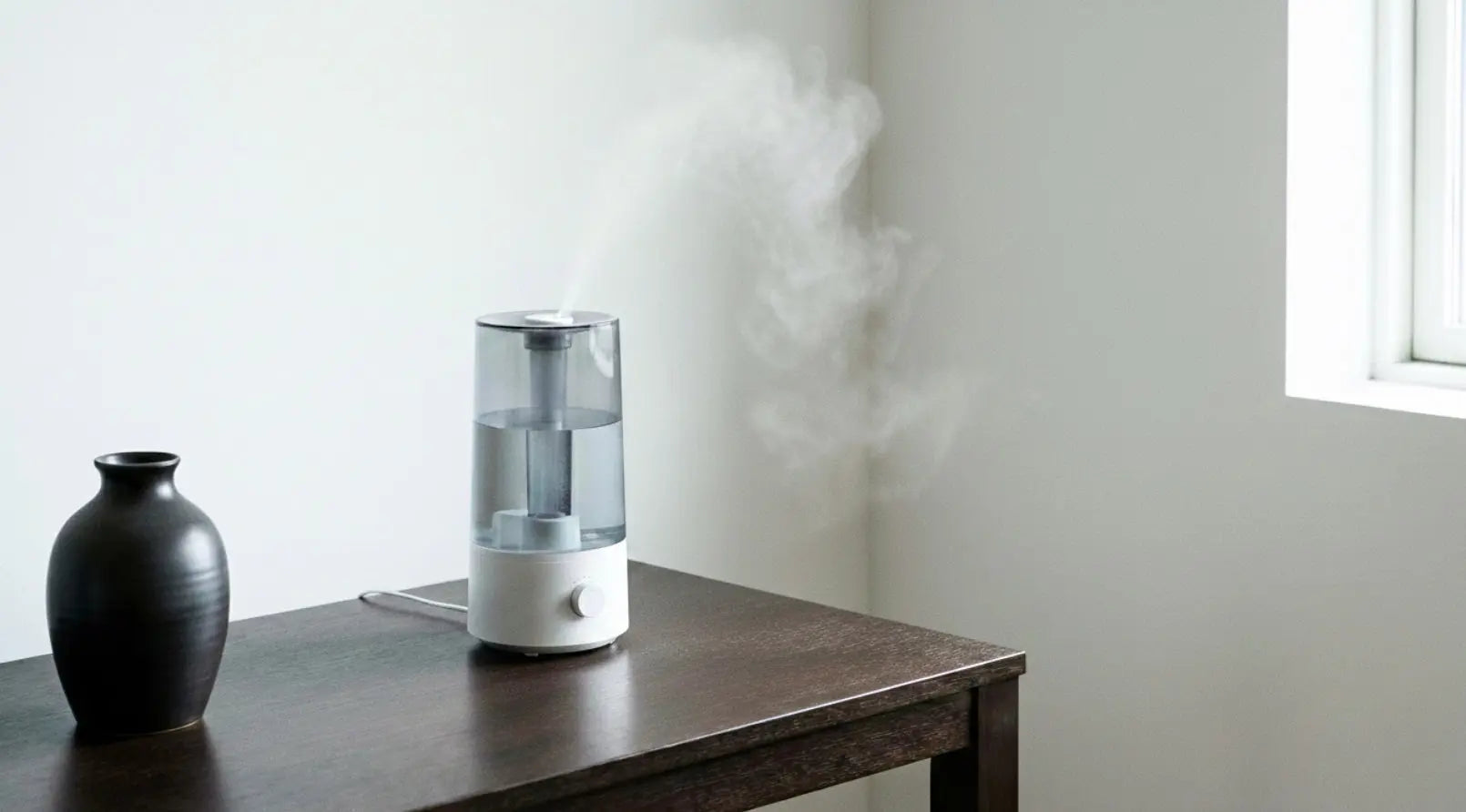
If you’ve been running an ultrasonic humidifier to deal with dry winter air, you’ve probably noticed a frustrating side effect: a fine, chalky white film settling on your furniture, electronics, and even your floor. It’s not regular household dust, it’s grittier, and no matter how much you wipe it away, it seems to return the next morning.
This phenomenon is commonly known as white dust from humidifier use. While it might seem like a minor cleaning nuisance, it’s actually a direct result of the mineral content in your home’s water supply. Understanding why this happens and how it affects your indoor air quality is essential for anyone trying to maintain a healthy home environment. In this article, we’ll break down the science of white dust and explain why Reverse Osmosis (RO) water is the most effective, professional-grade solution to stop it at the source.
1. Why Does White Dust Appear?
To understand why your humidifier is acting like a dust factory, we have to look at how different humidifiers work. Most modern households prefer ultrasonic humidifiers because they are quiet and energy-efficient. These devices use a small metal diaphragm that vibrates at an ultrasonic frequency. This vibration breaks water into a fine liquid mist, which is a process known as aerosolization.
The issue isn't the mist itself, but what is dissolved inside the water. Most tap water contains minerals, primarily calcium and magnesium. These are measured as Total Dissolved Solids (TDS). When an ultrasonic humidifier aerosolizes tap water, it flings everything in that water, including minerals, into the air. As the tiny water droplets evaporate in your room's dry air, the liquid disappears, but the solid minerals remain. They succumb to gravity and settle on your surfaces as white dust.
In contrast, evaporative humidifiers (which use a wick filter and a fan) rarely produce white dust. This is because the water evaporates from the wick, leaving the minerals behind in the filter. However, this leads to another problem: humidifier mineral buildup that turns the filter crusty and yellow, eventually rendering the machine useless. Whether it’s dust on your furniture or scale in your machine, the root cause is the same: hard tap water.
2. Is Humidifier White Dust Harmful?
While wiping down your furniture is an annoyance, the real concern is what this dust does to your indoor air quality. When minerals are aerosolized, they effectively become a form of particulate matter, specifically PM 2.5 (particles smaller than 2.5 micrometers).
According to the U.S. Environmental Protection Agency (EPA), breathing in high concentrations of minerals from humidifiers can be irritating to the lungs, especially for those with pre-existing conditions like asthma or allergies. Some users may even experience "Humidifier Fever," a flu-like illness caused by breathing in contaminated mist.
Beyond health concerns, humidifier mineral buildup and the resulting dust can cause several practical problems:
-
Electronics: Fine mineral dust is conductive and abrasive. If it settles inside your gaming console or PC, it can cause overheating or even short circuits over time.
-
Air Purifiers: If you run an air purifier alongside a humidifier, the white dust will quickly clog your expensive HEPA filters, forcing you to replace them much sooner than expected.
-
Bacterial Growth: Minerals don't just sit there; they create a textured surface inside your humidifier tank. This "scale" provides a perfect anchor for biofilm and bacteria to grow, making your humidifier much harder to sanitize.
3. Why RO Water for Humidifiers is the Practical Fix
If tap water is the problem, what is the fix? Many manuals suggest using distilled water. While distilled water works perfectly, it is often inconvenient and expensive for the average family:
-
The Cost: A single humidifier can easily use 1–2 gallons of water per day during peak winter. At roughly $1.50 per gallon, you could be spending $90 a month just to keep one room humidified. An undersink RO system pays for itself in just one or two seasons.
-
The Labor: Lugging heavy gallon jugs from the grocery store is a chore. Having a dedicated RO faucet at your sink provides an endless supply of purified water on demand.
-
Environmental Impact: Using distilled water creates a massive amount of single-use plastic waste. An RO system is a much more sustainable choice for the eco-conscious homeowner.
This is where RO water for humidifier use becomes the superior choice. Using Reverse Osmosis (RO) water is like giving your humidifier "pure fuel." By stripping away the heavy mineral load found in tap water, an RO system, like the FilterUnited 5-stage undersink model, transforms your indoor air quality:
-
Eliminates White Dust: By forcing water through a semi-permeable membrane with a 0.0001-micron rating, an RO system can remove up to 99% of minerals (TDS) found in tap water, it stops the chalky film from settling on your furniture and electronics.
-
Improves Air Quality: It prevents the aerosolization of minerals into PM 2.5 particles, reducing respiratory irritation for those with asthma or allergies.
-
Extends Device Life: Without "rock-hard" scale buildup on the ultrasonic membrane, your humidifier runs more efficiently and lasts significantly longer.
-
Cost-Efficient & Convenient: It provides a steady supply of purified water for pennies per gallon, eliminating the cost and plastic waste of buying bottled distilled water.
Since the calcium and magnesium have been stripped away by the RO membrane, there are no minerals left to create dust once the water evaporates. You get the benefit of perfectly humidified air without the chalky fallout.
4. Maintaining Your System for Peak Performance
Even when using purified water, maintenance is key to keeping your air healthy. Even the best water can become stagnant if left sitting for days. Here are a few professional tips:
-
Rinse Daily: Even with RO water, empty your humidifier tank every morning and let it air dry.
-
Weekly Deep Clean: Use a mixture of water and white vinegar to wipe down the base and the transducer (the vibrating plate). The RO water will make this job much easier because you won't have to scrub away "rock-hard" mineral scale.
-
Check Your RO Filters: To ensure your water remains mineral-free, change your RO membranes and pre-filters according to the manufacturer's schedule. A fresh membrane ensures your TDS levels stay near zero.
Conclusion: Breathing Easier with Purified Mist
The "white dust" is just water chemistry in action. While tap water is fine for many things, it simply isn't designed for the delicate mechanics of an ultrasonic humidifier. By switching to RO water, you protect your furniture, your electronics, and most importantly, your family's lungs.
Investing in a high-quality water filtration system does more than just provide clean drinking water; it transforms the very air you breathe. You’ll spend less time dusting and more time enjoying the crisp, comfortable atmosphere of a well-humidified home.


