

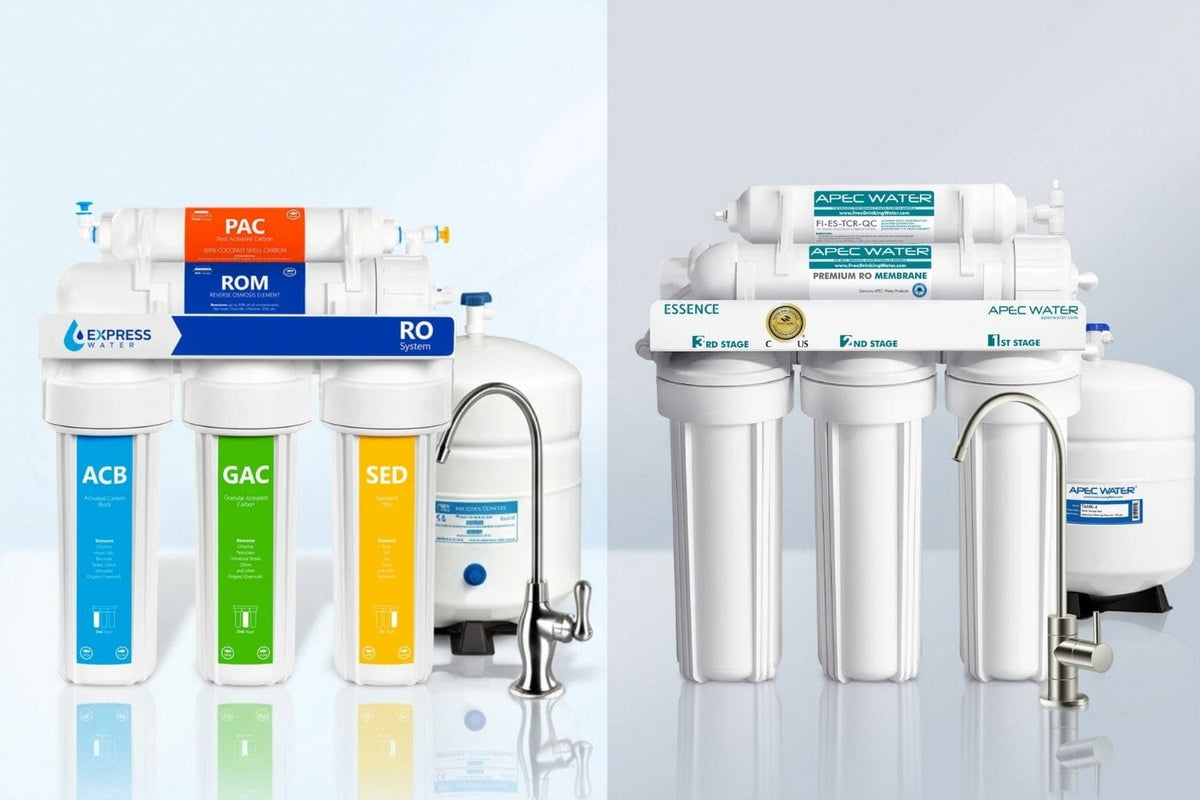
When shopping for an under-sink reverse osmosis system, Express Water and APEC Water Systems are two brands that often come up. Both offer traditional, tank-based RO systems designed for drinking and cooking water, but their products differ in certification, included features, replacement parts, and overall approach.
For this comparison, we’re focusing on the Express Water RO5DX and APEC ROES-50. Both are five-stage systems with 50-GPD-class RO membranes and 4-gallon storage tanks.
1. Filtration and Water Quality
At a basic level, the two systems follow the same RO treatment process. Water first passes through sediment and carbon filtration, which helps protect the RO membrane. The membrane then reduces many dissolved substances, while a final carbon stage helps polish the treated water.
The Express Water RO5DX is a five-stage system. Express Water advertises its RO systems as capable of reducing up to 99.99% of 158 impurities and TDS. However, a broad “up to” claim should not be interpreted as a 99.99% reduction for every contaminant.
The RO5DX is listed by NSF under NSF/ANSI 58, including a certified TDS-reduction claim. Certification applies to specific claims and test conditions, so it is more useful to look at the certification record than to compare headline percentages alone. NSF RO5DX certification listing
The APEC ROES-50 uses a 5-micron sediment filter, two carbon-block filters, a 50-GPD TFC RO membrane, and a final carbon filter. APEC identifies the ROES-50 as WQA Gold Seal Certified and states that it can reduce up to 99% of contaminants. APEC ROES-50 product page
These percentages should not be treated as a direct head-to-head performance test. Different companies can use different testing conditions, contaminant lists, and marketing language. If you are shopping because of a specific concern such as lead, nitrate, fluoride, arsenic, or PFAS, check the exact contaminant-reduction claim and certification for the model you're considering.
2. Capacity and Real-World Performance
The APEC ROES-50 has a 50-GPD membrane rating, while the RO5DX platform is offered in configurations with different membrane capacities.
It's important to understand what GPD actually means. The rating represents membrane production under specified test conditions. It does not mean your system will necessarily produce exactly that amount of purified water every day.
Water pressure, temperature, incoming water quality, membrane condition, and system setup can all affect production.
Both models use a 4-gallon storage tank, so the system doesn't have to produce drinking water instantly whenever you open the faucet. Instead, purified water is stored and available when needed.
For households using RO water mainly for drinking, cooking, coffee, and similar purposes, a 50-GPD-class system may provide adequate capacity. Larger households or homes with higher RO-water demand may want to consider a higher-capacity system.
In other words, don't choose a system solely because one model has a larger GPD number. Think about how much RO water your household actually uses.
3. Installation and System Design
Both systems are designed for installation beneath a kitchen sink and are intended to be accessible to homeowners who are comfortable with basic plumbing work.
The Express Water RO5DX uses quick-connect fittings and includes an emergency leak-stop detector. The detector is designed to stop water flow when it senses unwanted moisture, adding a useful layer of protection beneath the sink.
APEC also uses quick-connect fittings and standardized components on the ROES-50. APEC positions the system as suitable for DIY installation and provides installation instructions for homeowners.
However, calling either system universally “easier to install” would be misleading. Installation difficulty depends heavily on your existing plumbing, cabinet space, faucet setup, drain connection, and experience with plumbing projects.
One clear difference is the included leak protection: Express Water includes the leak-stop detector with the system, while APEC offers leak-detection accessories separately.
4. Replacement Filters and Long-Term Ownership
The purchase price is only one part of the cost of an RO system. Replacement filters are an important part of long-term ownership.
APEC currently lists a complete replacement filter set for the ROES-50 at $79.99. APEC recommends replacing its pre-filters approximately every 6–12 months, while the RO membrane and other downstream components generally last longer, depending on water quality and usage. APEC ROES-50 replacement filter set
The ROES-50 also uses standard-size 10-inch filter components. This can make it relatively straightforward to identify compatible replacement components, although buyers should always verify dimensions, specifications, and compatibility before using third-party filters.
Express Water also sells replacement filters and membranes for its RO systems. Replacement intervals vary by filter type and depend on factors such as incoming water quality and household usage. Express Water replacement filters
This is why comparing only the price of one replacement kit doesn't tell the whole story. A better comparison considers filter cost, replacement frequency, membrane life, and your home's water conditions.
5. Certifications and Warranty
Certification is another important difference between the two models.
The RO5DX appears in NSF's drinking-water-treatment-unit listings under NSF/ANSI 58, while APEC identifies the ROES-50 as WQA Gold Seal Certified. Neither certification should simply be labeled “better”. They are different third-party certification programs, and the relevant question is what claims have been evaluated for the exact model.
Warranty terms also differ slightly.
Express Water currently lists a one-year warranty for its residential RO systems.
APEC also provides a one-year standard warranty, but its warranty-registration program allows eligible customers to extend coverage to two years total when the product is registered within the required period. Buyers should review the current warranty terms before purchase because coverage conditions can apply.
6. Upgrade Options and Customization
Express Water puts considerable emphasis on system customization. Depending on the configuration, its RO platform can be paired with options such as alkaline, UV, and deionization filtration.
This can be useful for homeowners who have a specific reason for adding another treatment stage. However, additional stages aren't automatically better. For example, an alkaline stage changes the mineral profile and taste of the water, while UV treatment addresses a different type of water-quality concern.
APEC also offers a broader range of RO configurations, including alkaline and higher-capacity systems. The ROES-50 itself, however, is a conventional five-stage RO system.
The right number of stages depends on what you're trying to accomplish, not simply on which system has more components.
Which One Should You Choose?
Express Water RO5DX may make more sense if you want a lower current purchase price, included leak-stop protection, and more flexibility to choose additional treatment options.
APEC ROES-50 may be a better fit if you prefer a conventional five-stage system with WQA Gold Seal certification, standard-size replacement components, and the possibility of extended warranty coverage through registration.
Neither model is an obvious winner for every household. Their underlying RO technology is similar, so the decision comes down to the details that matter to you: certification, maintenance, price, installation, capacity, and additional features.
A Better Way to Make the Decision
Before choosing either system, start with your water rather than the product page.
If you're on municipal water, review your local water-quality report and consider additional testing if you have concerns about your home's plumbing or a particular contaminant. If you use a private well, testing is especially important because well-water conditions can vary significantly between properties.
Then compare the systems based on the specific contaminants you want to reduce, certified performance claims, membrane capacity, replacement schedule, warranty, installation requirements, and expected long-term cost.
This approach is more useful than choosing based on a single “99%” claim or simply counting the number of filtration stages.
Final Verdict
As of August 2026, the Express Water RO5DX has the lower listed purchase price at $189.99, compared with $230.99 for the APEC ROES-50. Express Water also stands out for its included leak-stop detector and range of optional configurations.
The APEC ROES-50 costs more initially but offers WQA Gold Seal certification, standardized 10-inch filter components, and the possibility of two years of warranty coverage with timely registration.
Ultimately, neither brand is universally better. The best choice is the system whose certified capabilities, maintenance requirements, capacity, and total ownership cost match your actual water and household needs.


