

Reverse osmosis (RO) remains the most effective technology for residential water purification, capable of removing up to 99% of dissolved solids and contaminants. As municipal water infrastructure faces increasing challenges, these systems are essential for ensuring compliance with EPA drinking water contaminant regulations for residential health.
The market of RO is currently split between two fundamentally different architectures: the traditional tank-based system and the modern tankless unit. While both rely on the same fundamental physical process and utilize semi-permeable membranes to filter water, their engineering philosophies, fluid dynamics, and long-term ownership costs differ significantly. This guide provides a technical deep-dive into these two architectures to help you evaluate which system aligns best with your specific water quality needs and maintenance expectations.
1. Traditional Tank-Based RO Systems
Traditional RO systems have been the industry standard for decades. Their design is rooted in modularity and mechanical simplicity, relying on atmospheric or bladder-based pressure rather than complex electronics.
Core Characteristics and Engineering
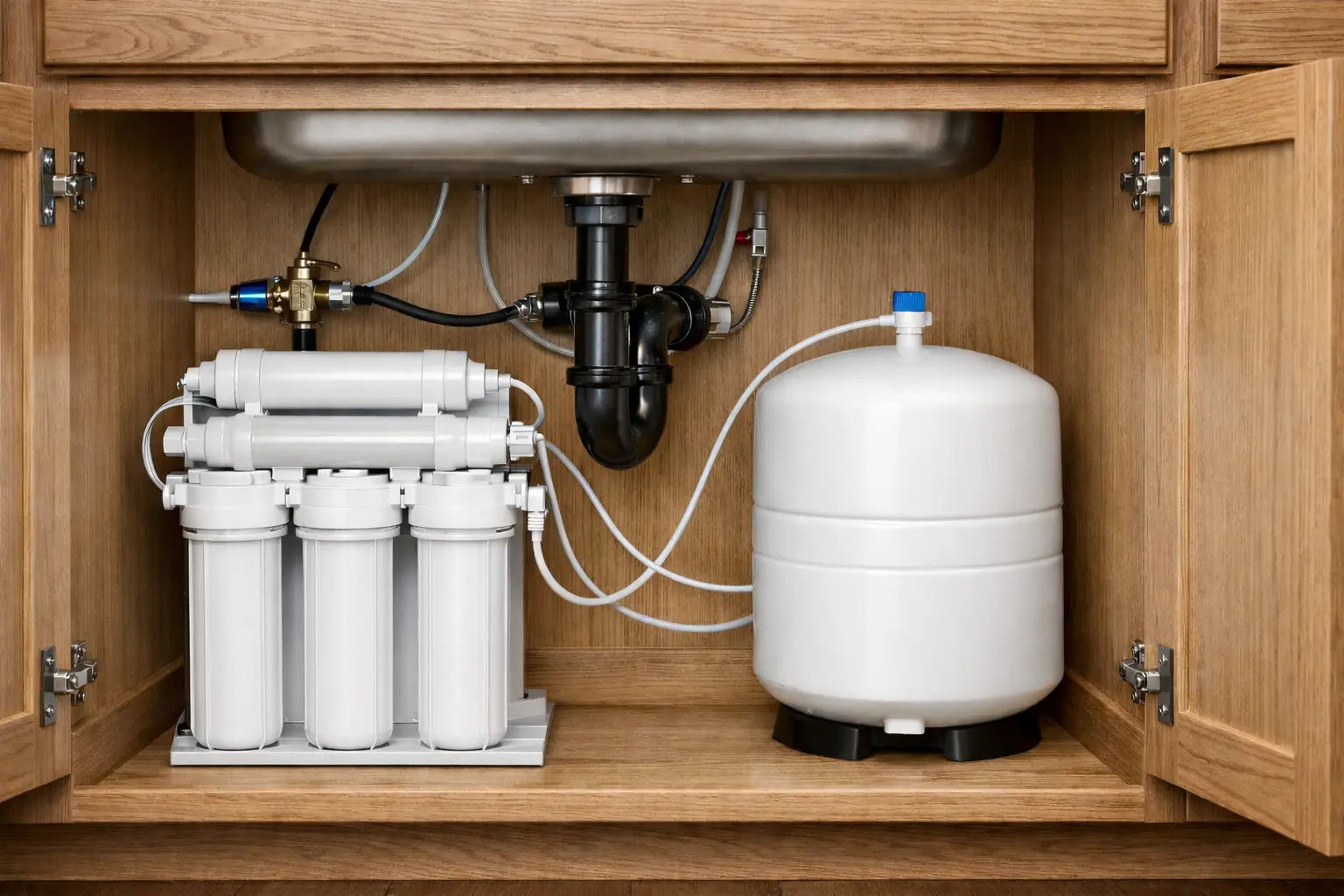
A traditional system is defined by its modular, multi-stage architecture, typically utilizing a 3-5+ stage filtration process. These systems rely on separate pre-filters, membrane, and post-carbon stages to ensure both water purity and membrane longevity.
The defining feature of this architecture is the pressurized storage tank. Because the RO process is inherently slow—filtering water drop by drop, the system works continuously to fill a 2-4 gallon tank. When you turn on the dedicated RO faucet, the air bladder inside the tank pushes the stored water through a final post-carbon "polishing" filter to your glass.
Key Engineering Advantages:
-
Modular Serviceability: Most traditional systems, such as those produced by industry leaders like APEC, use standardized 10-inch housing filters. This allows owners to source high-quality third-party filters rather than being locked into a single manufacturer.
-
Power Independence: These systems operate entirely on water pressure (mechanical energy). They do not require an electrical outlet under the sink, making them resilient during power outages.
-
Proven Longevity: With fewer moving parts and no electronic sensors or pumps, the chassis of a traditional system can last 10–15 years with basic O-ring and filter maintenance.
The modular architecture remains the industry benchmark for consistent water purification. Established manufacturers such as APEC Water Systems, Express Water, iSpring, VIVA21 and other industry leaders have long utilized this multi-stage design due to its serviceability and mechanical reliability. By maintaining separate housings for each filtration stage, these systems allow for targeted maintenance and ensure that the core RO membrane is protected from premature fouling.
2. Tankless RO Systems
Tankless (or "Direct Flow") RO systems represent a shift toward compact integrated appliance design. By removing the storage tank, these systems solve the issue of "spatial footprint" but introduce a new set of engineering requirements.
Core Characteristics and Engineering
To provide water on demand without a storage tank, these systems must filter water at a significantly higher rate, often 400 to 800 gallons per day (GPD). Achieving this requires a built-in electric booster pump to force water through the membrane at high velocity.
The filtration stages are often consolidated into "all-in-one" or "twist-and-pull" proprietary cartridges. These systems also feature integrated circuit boards to manage leak detection, filter life indicators, and automated membrane flushing cycles.
Key Engineering Advantages:
-
Compact Footprint: By eliminating the tank, these units occupy roughly 70% less space, making them ideal for modern urban kitchens.
-
Water Freshness: Because water is filtered "on-demand," there is no risk of water sitting stagnant in a storage tank for extended periods.
-
High Recovery Rates: Modern tankless systems are often engineered for higher efficiency, frequently reaching a 1:1 or 2:1 pure-to-waste water ratio, whereas older tank systems may tilt toward a 1:3 ratio.
The tankless market is characterized by manufacturers who prioritize integrated appliance design and digital monitoring. Industry leaders such as Waterdrop, and Frizzlife have developed systems that consolidate filtration stages into a single, compact chassis. These brands typically feature internal leak sensors, automated membrane flushing, and real-time TDS (Total Dissolved Solids) displays. By utilizing these integrated manifolds, they provide a streamlined installation process and a smaller spatial footprint, catering to modern kitchen environments where under-sink space is at a premium.
3. Engineering Comparison Overview: Performance & Reliability
|
Feature |
Traditional Tank-Based |
Tankless (Direct Flow) |
|
Flow Rate |
High (initial tank pressure) |
Fast & Consistent (pump-driven) |
|
Power Required |
No |
Yes (requires AC outlet) |
|
Complexity |
Low (Mechanical) |
High (Electronic/Mechanical) |
|
Waste Water |
Standard |
Lower (engineered efficiency) |
|
Standardization |
High (Universal parts) |
Low (Proprietary parts) |
The functional experience of these systems is defined by their delivery mechanics and water stability. A traditional tank-based system provides a fast initial flow due to stored pressure, though the flow weakens as the tank empties. Conversely, tankless systems offer a consistent but often slower stream indefinitely, limited by the speed of the internal pump.
This "on-demand" filtration also exposes the phenomenon of TDS Creep, where dissolved solids permeate the membrane during periods of rest. Traditional systems mask this by diluting the initial high-TDS water within the storage tank. Tankless systems, lacking this buffer, dispense "creep" water directly, often resulting in a temporary TDS spike during the first 15–30 seconds of flow unless the unit features an automated rinsing cycle.
4. Maintenance & 5-Year Cost Considerations
The "true cost" of a water filtration system extends beyond the purchase price, it is the cumulative result of the initial investment, recurring filter replacements, and component durability over a five-year horizon.
Initial costs are significantly higher for tankless systems, which often retail for double or triple the price of traditional units due to their integrated pumps and electronic controllers. While this upfront premium buys a smaller footprint, the long-term cost is further compounded by expensive proprietary filters, whereas traditional systems utilize low-cost, universal parts.
Traditional Systems: Low Maintenance Costs, High Hands-On
The maintenance of a traditional system is highly economical. Because they use standardized filters, consumers can shop for the best value in sediment and carbon blocks. Over five years, the primary costs are:
-
Annual Filter Changes: ~$40–$80/year.
-
Membrane Replacement (Every 3 years): ~$40–$60.
-
Total 5-Year Estimate: ~$300.
-
Note: Replacing the tank bladder (if it fails) is a simple $50 fix.
Tankless Systems: High Maintenance Costs, Low Labor
Tankless systems utilize proprietary cartridges. While easier to swap (often a 5-second "click"), they are significantly more expensive. Furthermore, if the internal booster pump or the control board fails after the warranty period, the unit is often difficult or impossible to repair.
-
Annual Filter Changes: ~$100–$150/year.
-
Membrane Replacement (Every 2-3 years): ~$100–$150.
-
Total 5-Year Estimate: ~$800.
-
Note: These systems require electricity, adding a nominal amount to the annual utility bill. These units are subject to 'proprietary lock-in', meaning if the manufacturer discontinues your specific cartridge model, the entire system effectively becomes e-waste.
5. Certification and Compliance: Why Standards Matter
Regardless of the system’s architecture, the efficacy of an RO unit is only as good as its third-party validation. In an industry where performance claims can be easily exaggerated, homeowners should rely on two primary certifications to ensure their water is truly safe:
-
NSF/ANSI 58: This is the specific gold standard for point-of-use reverse osmosis. Unlike general carbon filter standards, Standard 58 subjects the system to rigorous "stress tests." It verifies the system's ability to reduce specific contaminants such as arsenic, lead, and Total Dissolved Solids (TDS), while ensuring the pressure vessel (the tank or manifold) can withstand thousands of cycles of household water pressure without structural failure.
-
NSF/ANSI 372: This certifies that the system is "lead-free." It specifically audits the chemical composition of every component that touches your water such as faucets, tubing, and connectors, ensuring that the materials themselves do not leach harmful metals back into the purified water.
Choosing a system without these certifications significantly increases the risk of "filter bypass", where water escapes filtration due to poor internal seals, or the use of substandard plastics that may degrade over time. For a detailed breakdown of how these marks protect the consumer, you can read our NSF certification explanation blog page.
The Water Quality Association (WQA) also provides a searchable Official WQA directory listing of certified products, allowing consumers to verify that a manufacturer's claims are backed by actual laboratory data. For a deeper understanding of the rigorous laboratory protocols and what these tests entail, you can review the NSF certification explanation.
Conclusion: Which System is Right for You?
The decision between traditional and tankless RO systems ultimately hinges on the user's priorities:
-
Choose a Traditional Tank-Based System if: You value long-term cost-efficiency, prefer standardized parts that aren't tied to one manufacturer, and want a system that works during a power outage. It is the "DIY-friendly" choice for the budget-conscious homeowner.
-
Choose a Tankless RO System if: Under-sink space is at a premium, you prefer the convenience of "click-in" filter changes, and you are willing to pay a premium for a modern, integrated appliance that reduces water waste.
While tankless systems offer a modern, space-saving aesthetic, the traditional tank-based architecture remains the superior choice for those prioritizing longevity and low maintenance costs. To explore models built on this time-tested engineering, browse the selection of traditional RO systems at FilterUnited. Both systems provide excellent water quality when properly maintained and certified to industry standards. By understanding the engineering trade-offs, you can ensure your home’s water filtration strategy remains sustainable for years to come.


