

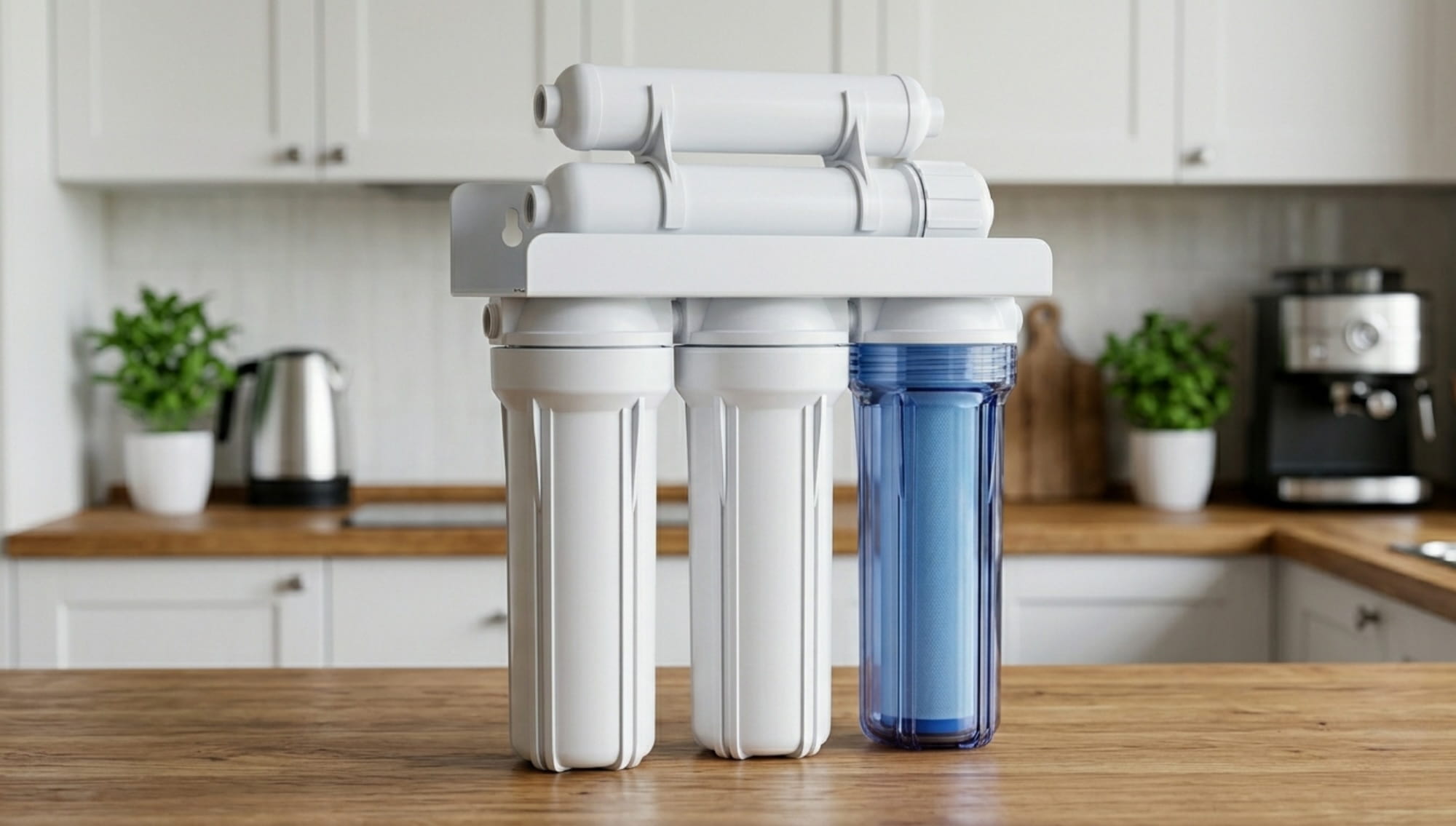
Water is the essence of life, but the journey it takes to reach your kitchen faucet is often more complex than we realize. While municipal treatment plants do an admirable job of making water "safe" by regulatory standards, the path from the plant to your home involves miles of aging infrastructure, lead-lined pipes, and the potential for biofilm growth.
We live in an era of unprecedented convenience, yet our water quality faces emerging threats that traditional carbon pitchers simply weren't designed to handle. From microplastics and pharmaceutical runoff to "forever chemicals" (PFAS), the "invisible contaminants" in our water require a more sophisticated solution.
Enter Reverse Osmosis (RO). Far more than just a filter, an RO system is essentially a high-tech water reclamation plant for your home. It’s the same technology trusted by premium bottled water brands and global desalination plants. To achieve true purity, RO systems utilize a "symphony of stages", where each filter acts as a specialist to ensure the final output is consistently clean, safe, and delicious.
Stage 1: The Mechanical Sentinel – Sediment Filtration
The first line of defense in any high-quality RO system is the Sediment Filter. Think of this stage as the "bodyguard" for the entire system.
The Barrier and Micron Rating
Most quality RO systems use a high-density Polypropylene (PP) filter. These are categorized by their micron rating—typically around 5 microns. To put that in perspective, a human hair is about 70 microns wide. This stage is designed to catch the "heavy hitters" before they can reach the more sensitive components of the system.
Target Contaminants
-
Rust: Common in homes with older iron pipes.
-
Silt and Sand: Fine particles that can enter the line during water main breaks or construction.
-
Clay and Scaly Debris: Physical matter that causes turbidity (cloudiness) in water.
Strategic Function
By removing these abrasive physical particles, the sediment filter protects the subsequent carbon blocks and the delicate RO membrane from premature clogging or physical "scouring". Without this stage, the rest of the system would fail within weeks.
Stages 2 & 3: The Chemical Adsorbents – Activated Carbon Blocks
Once the physical debris is gone, the water moves into the chemical treatment phase. Most premium systems use a dual-stage carbon approach to ensure no stone is left unturned.
The Science of Adsorption
It is important to distinguish between absorption (like a sponge soaking up water) and adsorption. Activated carbon works through adsorption, where contaminants physically stick to the surface of the carbon granules. The "activation" process creates millions of tiny pores, giving a single gram of activated carbon a surface area equivalent to several football fields.
The "Dual" Advantage
Why two stages?
-
Stage 2: This stage tackles the bulk of the work, focusing primarily on chlorine. While chlorine is great for killing bacteria in city pipes, it tastes terrible and can chemically damage an RO membrane.
-
Stage 3: This acts as a "polishing" adsorbent. It captures Volatile Organic Compounds (VOCs), pesticides, herbicides, and industrial solvents that might have bypassed the first block.
Sensory Impact
This is where you notice the biggest change in the "experience" of your water. By removing the "swimming pool" smell of chlorine and metallic odors, the water begins to taste neutral and clean, perfectly prepared for the molecular purification that follows.
Stage 4: The Heart of the System – The RO Membrane
This is the most critical and technically advanced part of the process. If the previous stages were about cleaning the water, this stage is about purifying it at a molecular level.
Molecular Sifting
The Reverse Osmosis membrane is a semi-permeable barrier with a pore size of approximately 0.0001 microns. At this scale, we are no longer just filtering particles; we are sifting molecules.
To visualize the scale: if a water molecule were the size of a marble, a typical virus would be the size of a large truck, and a bacterium would be the size of a jet engine. The RO membrane is designed to let the "marbles" (water) through while blocking almost everything else.
The Rejection Process & Cross-Flow Filtration
Unlike a standard filter that traps dirt inside its fibers (and eventually gets "full"), an RO membrane uses cross-flow filtration. The system sends the purified water (permeate) to your tank, while a constant stream of "reject water" (concentrate) washes the contaminants off the membrane and down the drain.
This self-cleaning mechanism allows the system to remove up to 99% of Total Dissolved Solids (TDS), including:
-
Lead and Arsenic
-
Fluoride
-
Nitrates and Sulfates
-
PFAS (Forever Chemicals)
Stage 5: The Refinement Phase – Post-Carbon Polishing
After passing through the membrane, the purified water is usually stored in a pressurized tank so it's ready when you turn on the faucet. However, because water can sit in this tank for a period of time, it needs a final "refresh".
The Finishing Touch
Stage 5 is a Post-Carbon Polishing Filter, usually made from high-quality coconut shell activated carbon. As the water travels from the storage tank to your glass, it passes through this final filter to "scrub" any lingering tastes or odors that might have been picked up from the storage bladder.
The Experience
This stage ensures that the water is as fresh and crisp as a mountain spring the moment it hits your glass, eliminating any "tank taste" and providing that premium mouthfeel.
Stage 6 (Premium Option): Restoration – Alkaline Remineralization
While the 5-stage process produces incredibly pure water, it can sometimes be too pure. Because RO removes everything, it also removes the natural minerals that give water a slightly alkaline pH. This can result in water that is slightly acidic.
Nature’s Mimicry
The optional 6th stage—Alkaline Remineralization—mimics the natural process of water flowing over river stones. As the water passes through this filter, it re-introduces essential ionized minerals such as Calcium, Magnesium, and Potassium.
The pH Benefit
By balancing the pH to a slightly alkaline level, the water becomes more "living". This results in a smoother mouthfeel, better flavor for coffee and tea, and—according to many enthusiasts—superior hydration.
Conclusion: An Investment in Your Health
An RO system is not just a kitchen appliance; it’s a holistic approach to wellness. By understanding these stages, you can see how they work in harmony: the first stages protect the membrane, the membrane performs the heavy lifting, and the final stages ensure the taste is perfect.
Why It Matters
-
Total Security: You are no longer reliant on the integrity of city pipes. You have a final, absolute barrier against lead and chemicals.
-
Sustainability: One RO system can replace thousands of single-use plastic bottles per year, drastically reducing your environmental footprint.
-
Cost-Effectiveness: Over time, the cost per gallon of RO water is a fraction of the cost of bottled water.
It’s time to stop thinking about your water as just a utility and start thinking about it as a foundation for health. Transitioning from "drinking water" to optimized hydration is one of the simplest and most impactful changes you can make for your home.
Are you ready to experience the difference that a multi-stage defense can make? Explore our range of RO systems today and take control of your tap.


