

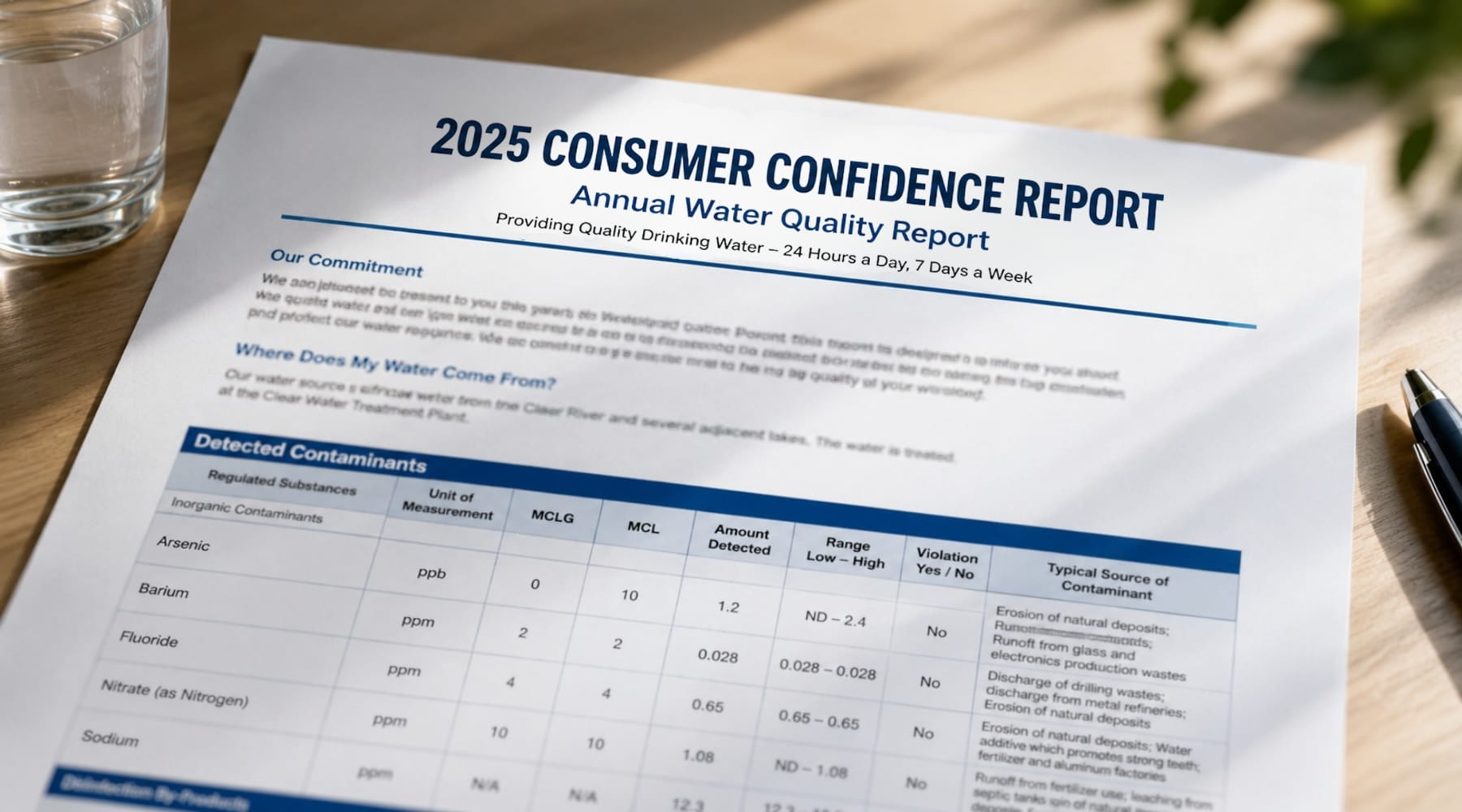
Every year, usually by July 1st, water suppliers across the United States are required by law to deliver an annual water quality report to their customers. Formally known as the Consumer Confidence Report (CCR), this document tells you where your water comes from and what is in it.
But let’s be honest: opening a CCR is like trying to read a foreign language. It is dense, filled with scientific jargon, acronyms, and complex tables. It is no surprise that many of these reports go straight from the mailbox to the recycling bin.
Ignoring this report is a mistake. While municipalities do their best to treat water, understanding what ends up in your tap is crucial for your family's health.
This blog will go through exactly how to read your local water quality report, help you understand key terms, and reveal why even a report that meets federal standards might not mean your water is perfectly pure.
Why You Need to Read Your CCR
The Environmental Protection Agency (EPA) sets legally enforceable standards for public water systems.However, a "passing grade" on a CCR doesn't mean your water is free of all contaminants.
Furthermore, these reports only measure water at the treatment plant. They do not account for contaminants that enter the water as it travels through aging infrastructure (like lead pipes) to your specific home. Understanding this document is the first step toward deciding if you need a home water filtration system to ensure the highest quality drinking water.
Key Sections of a Water Quality Report
While every CCR looks slightly different, they all contain the same essential components. Here is what to look for:
1. Water Source: The report will indicate if your water is surface water (from rivers, lakes, reservoirs) or groundwater (from aquifers and wells). This matters because different sources are prone to different types of contamination. Surface water is more susceptible to runoff (pesticides, road salt), while groundwater often has higher levels of dissolved minerals.
2. Definitions of Terms (The Glossary): This is the most critical section for deciphering the data table. Do not skip this. You will need to understand these specific acronyms to interpret the numbers.
3. The Contaminant Table: This is the heart of the report. It lists the detected contaminants, the levels found,and how those levels compare to EPA standards.
Cracking the Code: The Definitions You Must Know
When you look at the table, you will see several columns with confusing headings. Here is what they actually mean:
-
MCL (Maximum Contaminant Level): This is the highest level of a contaminant allowed in drinking water. MCLs are enforceable standards. They are set as close to the MCLG as feasible using the best available treatment technology and taking cost into consideration.
-
MCLG (Maximum Contaminant Level Goal): This is the level of a contaminant in drinking water below which there is no known or expected risk to health. MCLGs allow for a margin of safety and are non-enforceable public health goals. Note: For carcinogens (cancer-causing substances), the MCLG is often set at zero.
-
AL (Action Level): The concentration of a contaminant which, if exceeded, triggers treatment or other requirements that a water system must follow. This is usually applied to Lead and Copper.
-
ppm (Parts per Million) / ppb (Parts per Billion): These describe units of measure. To put it into perspective, one ppm is like one drop of water in a hot tub. One ppb is like one drop of water in an Olympic-sized swimming pool. Even seemingly tiny amounts (ppb) of certain contaminants can be harmful over time.
The Hidden Fact in the Table
Just because your report shows that your water is "in compliance" with MCLs, it doesn't mean it is entirely free of risks. Here are the hidden contaminants and nuances you need to watch out for:
1. Contaminants Found Below the MCL but Above the MCLG This is the most common "hidden" issue. A contaminant might be present at a level that is legally acceptable (below MCL) but is still higher than what health scientists deem ideal (MCLG). If your report lists a contaminant with an MCLG of zero, any detected amount means there is a theoretically non-zero risk over long-term consumption.
2. Regulated vs. Unregulated Contaminants The EPA currently regulates over 90 contaminants. However, thousands of other chemicals exist that are not yet regulated. Many CCRs will have a section for "Unregulated Contaminants". Water systems test for these to help the EPA determine if they should be regulated in the future. Things like PFAS/PFOS (the so-called "forever chemicals") are only just beginning to be regulated, yet they have been present in many water systems for years.
3. Lead and Copper: The Plumbing Problem Lead is rarely present in source water. It enters drinking water through the corrosion of plumbing materials inside the home or the service lines connecting the home to the water main. Because the water system only samples a small number of high-risk homes, the results for Lead and Copper in the CCR might not accurately reflect the levels in your specific tap. If you live in an older home, this is a significant concern.
4. Secondary Contaminants Some substances affect the taste, odor, or color of water but do not pose a direct health risk. These are called Secondary Contaminants (e.g., iron, manganese, total dissolved solids). While not harmful, high levels can make drinking water unpleasant and can stain fixtures or damage appliances.
Beyond the Report: Taking Control of Your Water Quality
Reading your CCR is an excellent educational step, but it often raises more questions than it answers. If you are concerned about contaminants between the treatment plant and your tap, or if you simply want to lower the levels of substances that are below the MCL but above the MCLG, you have options.
The next logical step is to perform a targeted tap water test in your own home, particularly for lead.
For ultimate peace of mind and the removal of the widest range of contaminants, many homeowners opt for a high-quality under-sink water filter.
Among the various technologies available, reverse osmosis systems are widely considered the gold standard for home water purification. Unlike simple carbon filters that mainly improve taste by removing chlorine, a Reverse Osmosis (RO) system uses a semi-permeable membrane to effectively reduce up to 99% of contaminants, including lead, arsenic, fluoride, TDS, nitrate, and many emerging chemical contaminants that local reports might barely mention.
Investing in a proper drinking water filtration system is an investment in your long-term health. By moving beyond the generic municipality report and taking control of the water at your specific kitchen faucet, you can ensure that the water you and your family drink is as pure and safe as possible.
Don't Drown in Data—Demand Better Water
Your local water quality report provides a snapshot of what is happening at the source. It is up to you to manage what comes out of the tap. Understanding how to read the CCR empowers you to make informed decisions about your water quality. If the report reveals contaminants you are uncomfortable with, or if you simply want to guarantee the purest possible water, exploring the best water purifiers for home use is the next smart step on your journey to healthier living.


