

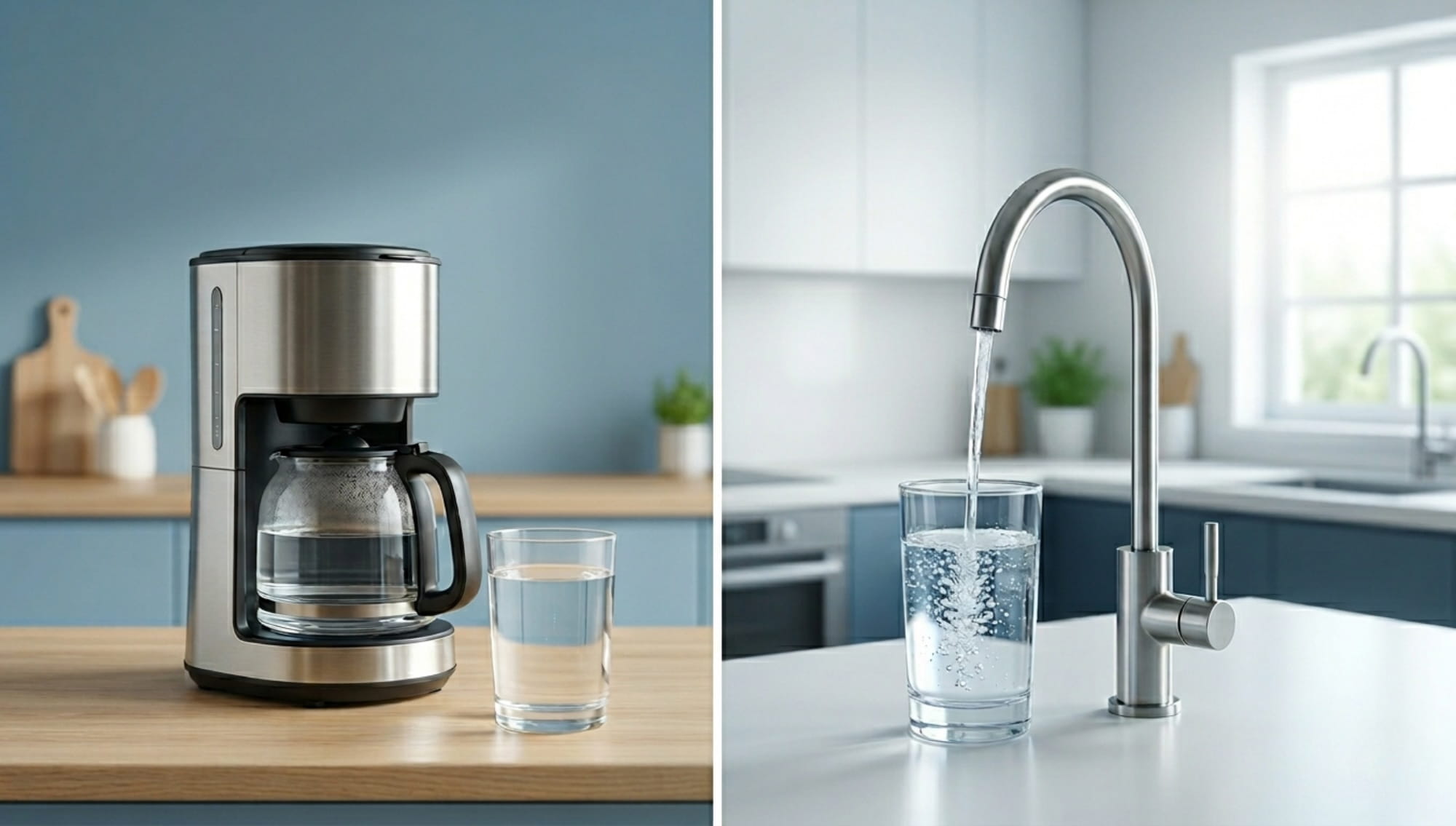
In recent years, American homeowners have become increasingly concerned about what comes out of their kitchen faucets. From aging infrastructure to reports of lead, PFAS ("forever chemicals"), and microplastics, the quality of our tap water is no longer something we take for granted.
When you start looking for a solution to ensure your family has the cleanest water possible, two methods consistently stand at the top: Distillation and Reverse Osmosis (RO). Both are considered the "gold standards" of water purification, but they work in fundamentally different ways.
If you are trying to decide which system to invest in, it is important to understand how they compare in terms of science, cost, and daily convenience. This guide will break down everything you need to know to make an informed choice for your household.
1. What is Distilled Water?
Distillation is one of the oldest methods of water purification. It mimics the natural hydrologic cycle, which is the same way the earth creates rain.
The process is straightforward: water is heated in a boiling chamber until it turns into steam. As the water evaporates, it leaves behind heavy impurities like minerals, bacteria, and lead because these substances cannot turn into gas at the boiling point of water. The steam then travels into a cooling coil where it condenses back into a liquid state. This collected liquid is distilled water.
Historically, distilled water has been the go-to for specialized uses. Because it is almost entirely free of minerals and impurities, it is ideal for car batteries, steam irons, and medical devices like CPAP machines, where mineral buildup could damage the equipment.
2. What is Reverse Osmosis (RO) Water?
While distillation uses heat, Reverse Osmosis uses pressure and technology. At the heart of an RO system is a semi-permeable membrane with incredibly tiny pores—approximately 0.0001 microns in size. To put that in perspective, that is about 100,000 times smaller than the width of a human hair.
In a typical home RO system, your household water pressure pushes water through this membrane. The membrane acts as a physical barrier, allowing water molecules to pass through while trapping 99% of dissolved solids, chemicals, and salts.
However, a modern RO system is rarely just a membrane. It is usually a multi-stage process. Most systems include a sediment filter to catch sand and rust, and a carbon filter to remove chlorine and organic chemicals before the water even reaches the RO membrane. This team effort ensures the water is not only pure but also tastes great.
3. Comparing the Two Methods
Speed and Capacity
One of the most immediate differences you will notice is how fast you can get a glass of water.
-
Distillation: Most countertop distillers are quite slow. It typically takes about 4 to 6 hours to produce a single gallon of water. If you have a large family or like to use purified water for cooking, a distiller may struggle to keep up with your daily demand.
-
Reverse Osmosis: RO systems are designed for on-demand use. Traditional RO systems use a pressurized storage tank, which ensures a very fast and steady flow of water the moment you turn the faucet. On the other hand, many modern "tankless" designs are now popular in American kitchens for their space-saving benefits, providing a continuous stream of fresh water without taking up cabinet space.
Energy Efficiency
In an era of rising utility bills, energy consumption matters.
-
Distillation: This process requires a significant amount of electricity because the system must keep water at a constant boil for hours.
-
Reverse Osmosis: RO is remarkably efficient. It primarily relies on the existing water pressure in your home to function. While some high-output systems use a small electric pump to increase efficiency, the energy footprint is negligible compared to boiling gallons of water.
Taste and Culinary Use
Does pure water always taste good? Not necessarily.
-
Distilled Water: Many people describe distilled water as "flat". This is because the boiling process removes all dissolved oxygen and minerals. While it is very pure, it lacks the crispness we usually associate with refreshing water.
-
RO Water: RO water is generally preferred for drinking. Because it doesn't boil the water, it retains a more natural, refreshing taste. It is the standard for high-end coffee shops and restaurants because it allows the true flavors of coffee, tea, and food to shine through without the interference of chlorine or heavy minerals.
Maintenance and Ease of Use
How much work are you willing to do to keep the system running?
-
Distillation: Because all the "junk" is left behind in the boiling chamber, distillers develop a thick crust of mineral scale (calcium and magnesium) very quickly. This requires frequent manual scrubbing or descaling with vinegar or citric acid to keep the machine sanitary.
-
Reverse Osmosis: Maintenance is much simpler. There is no boiling chamber to scrub. Instead, you simply swap out the filter cartridges once or twice a year. Most modern systems feature "twist-and-pull" filters that take less than a minute to change.
Contaminant Removal
Both systems are excellent at removing heavy metals and bacteria, but there is a nuance regarding chemicals.
-
Distillation: While some distillers use a small carbon post-filter, the distillation process itself cannot effectively block VOCs with boiling points lower than water.
-
Reverse Osmosis: Because RO systems incorporate carbon filtration stages, they are exceptionally effective at removing VOCs, pesticides, and chlorine, providing a more comprehensive shield against modern chemical pollutants.
4. Environmental Impact
Choosing either of these systems is a massive win for the environment. The average American household that switches to a home filtration system saves hundreds of single-use plastic bottles from entering landfills and oceans every year.
However, when comparing the two, RO is generally considered more "green" due to its lower energy consumption. Distillation requires constant electricity, which, depending on your local power grid, carries a higher carbon footprint than a pressure-based RO system.
5. Which is Best for You?
So, how do you choose? It really comes down to your specific needs.
Choose Distillation if:
-
You only need a small amount of water for specific appliances like a CPAP machine, a humidifier, or a steam iron.
-
You don't mind waiting several hours for a batch of water.
-
You want a portable countertop unit and don't want to perform any plumbing installation.
Choose Reverse Osmosis if:
-
You want high-quality drinking water available instantly for your whole family.
-
You want a system that is energy-efficient and easy to maintain.
-
You want better-tasting coffee, clearer ice cubes, and tastier home-cooked meals.
-
You are looking for a long-term, convenient solution that integrates directly into your kitchen.
For the modern American home, Reverse Osmosis is almost always the more practical and enjoyable choice. It provides the purity of a laboratory with the convenience of a modern appliance.
If you're ready to upgrade your home's hydration, explore our range of RO systems designed to fit every kitchen and lifestyle. Your family deserves water that is not just clear, but truly pure.


