

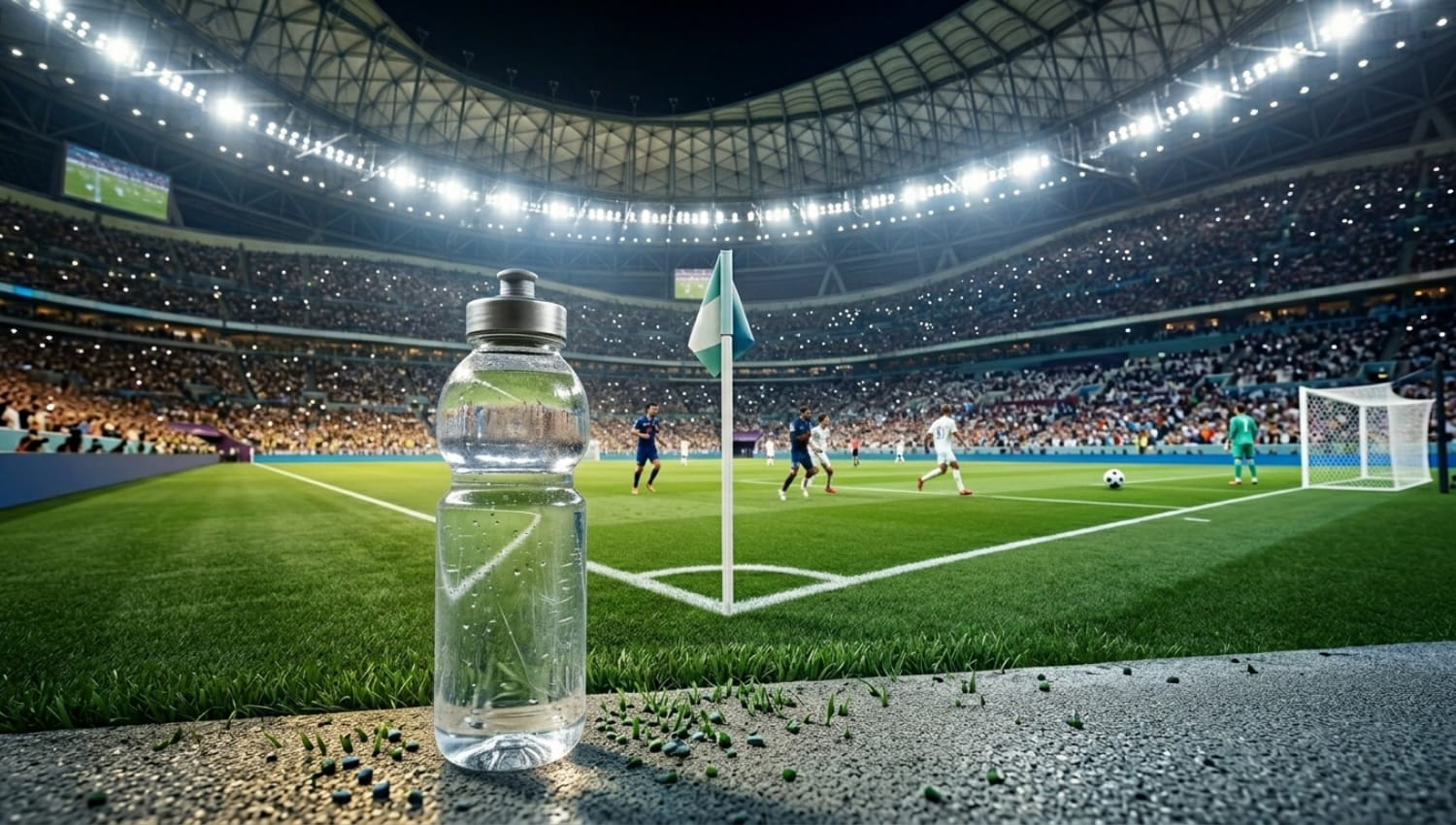
Starting in 2026, the 90-minute rhythm is changing. FIFA has officially mandated a 3-minute hydration break around the 22nd minute of each half. This will be imposed to every single game at World Cup FIFA 2026, regardless of the stadium or the weather conditions.
This shift is more than just a quick drink. It’s a rule that might alter the rhythm of the match and the performance of every player on the pitch.
FIFA is Tossing the Thermometer
For years, hydration breaks were the exception, not the rule. Under the old system, “Cooling Breaks” only happened if the thermometer hit a brutal 32°C (89.6°F) on the wet-bulb globe temperature scale. It was a reactive measure. If it wasn't scorching hot, the players simply had to grind through the full 45 minutes without a drop.
The turning point started back in Brazil 2014, where the heat was so dangerous that a Brazilian labor court actually had to order FIFA to implement breaks or face massive fines. More recently, during the 2025 Club World Cup in the U.S., players were seen visibly struggling in high humidity even when the temperature didn't hit that “official” threshold. The Pitches in Peril report also found that 10 of the 16 venues for the 2026 World Cup are at “very high risk of experiencing extreme heat stress conditions.”
As a result, for the 2026 World Cup, FIFA is tossing the thermometer out the window. This new mandate applies to every single match, regardless of whether it’s a chilly night in Toronto or a humid afternoon in Monterrey.
“For every game, no matter where the games are played, no matter if there’s a roof, (or) temperature-wise, there will be a three-minute hydration break. It will be three minutes from whistle to whistle in both halves.” said Manolo Zubiria, the Chief Tournament Officer for the FIFA World Cup 2026 at the world broadcaster meeting.
FIFA calls this a “streamlined and simplified version” of the earlier practice. By standardizing these breaks, FIFA has essentially turned the football game into 4 distinct phases, ensuring that every player has a fair, predictable window to reset and stay hydrated.
This 3-Minute New Rule is a Tactical Necessity
According to the American College of Sports Medicine (ACSM), elite athletes begin to experience increasingly “thermal strain” and “cardiovascular drift” when they lose just 2% of their body weight through sweat. For an average 75kg (165lb) player, that is a loss of only 1.5kg of fluid, which is a threshold easily crossed within the first 25 minutes of high-intensity sprinting in humid conditions.
When a player hits this 2% dehydration mark, the consequences are immediate but often invisible to the naked eye:
-
Plasma Volume Drop: As blood becomes more viscous (thicker), the heart must work significantly harder to pump oxygen to the muscles. Research shows that even mild dehydration like 1% of body mass increases heart rate by 3–5 beats per minute at the same work intensity.
-
Cognitive Erosion: Most critically for football, dehydration attacks the legs as well as the brains. Once severe dehydration happens, athletes suffer a significant drop in cognitive function. For a playmaker, this means slower decision-making and a measurable decline in passing accuracy. In a game of inches like the World Cup, these “marginal” losses are often the difference between a goal and a turnover.
Why 22 Minutes?
In the extreme heat predicted for 10 of the 16 World Cup venues, a player’s core temperature can rise to dangerous levels long before the halftime whistle. The Pitches in Peril report emphasizes that without a mid-half intervention, players might enter a state of “uncompensated heat stress”.
By mandating a reset around the 22nd minute, FIFA is effectively preventing “Heat Accumulation”. This 3-minute window allows the body’s internal cooling system to recalibrate, ensuring that the final 20 minutes of the half are played at peak intensity rather than in a state of physical survival. As the data suggests, the goal isn't just to keep players standing, it's also to keep their clinical edge sharp when the game is on the line.
Will This be a Momentum Killer?
For many football purists, the most controversial part of the mandatory 3-minute break isn't the water—it's the interruption. Football has traditionally been a game of continuous flow, where physical and mental fatigue are part of the contest. By forcing a stop, FIFA is changing the natural rhythm of the match.
Many national teams already tested these breaks during their March friendlies. It didn't take long for coaches to realize just how much this mid-half pause can shift the game’s balance.
Breaking the Wave
Managers who rely on high-intensity pressing, like Mauricio Pochettino, have previously pointed out that he was “annoyed” by these hydration breaks.
In a standard 90-minute game, a dominant team often uses the 20-to-30-minute mark to tire out their opponent. When defenders start to lose their breath and their formation breaks down, that is usually when a goal happens. Now, a struggling team gets a “free” 3-minute window to recover. They can catch their breath, fix their defensive line, and reset the emotional pressure that the attacking team spent 20 minutes building.
A New Window for Precision
On the other side of the touchline, technical strategists like Didier Deschamps or Roberto Martinez may see these 180 seconds as a vital opportunity for precision. In elite football, small positioning errors can be fatal, and a mid-half break allows for immediate correction rather than waiting until halftime.
Instead of shouting instructions that get lost in the stadium noise, managers can pull key players aside for a focused briefing. Expect to see coaching staff rushing to the sideline with iPads. In 2026, the middle of each half will likely become a high-speed briefing where players see their mistakes on screen before the game restarts.
Conclusion
The 2026 World Cup introduces a new rhythm to the international game. It is a "tactical stop" where momentum can completely change. While the coaching staff uses this window for quick fixes, the physical priority remains the same. In the extreme heat of the host cities, the speed of a player’s physiological recovery is just as critical as any sideline adjustment. Mitigating dehydration is the best way to maintain a clinical edge until the final whistle. In 2026, the teams that manage these transitions most effectively are likely the ones that sustain their intensity until the final whistle.


