

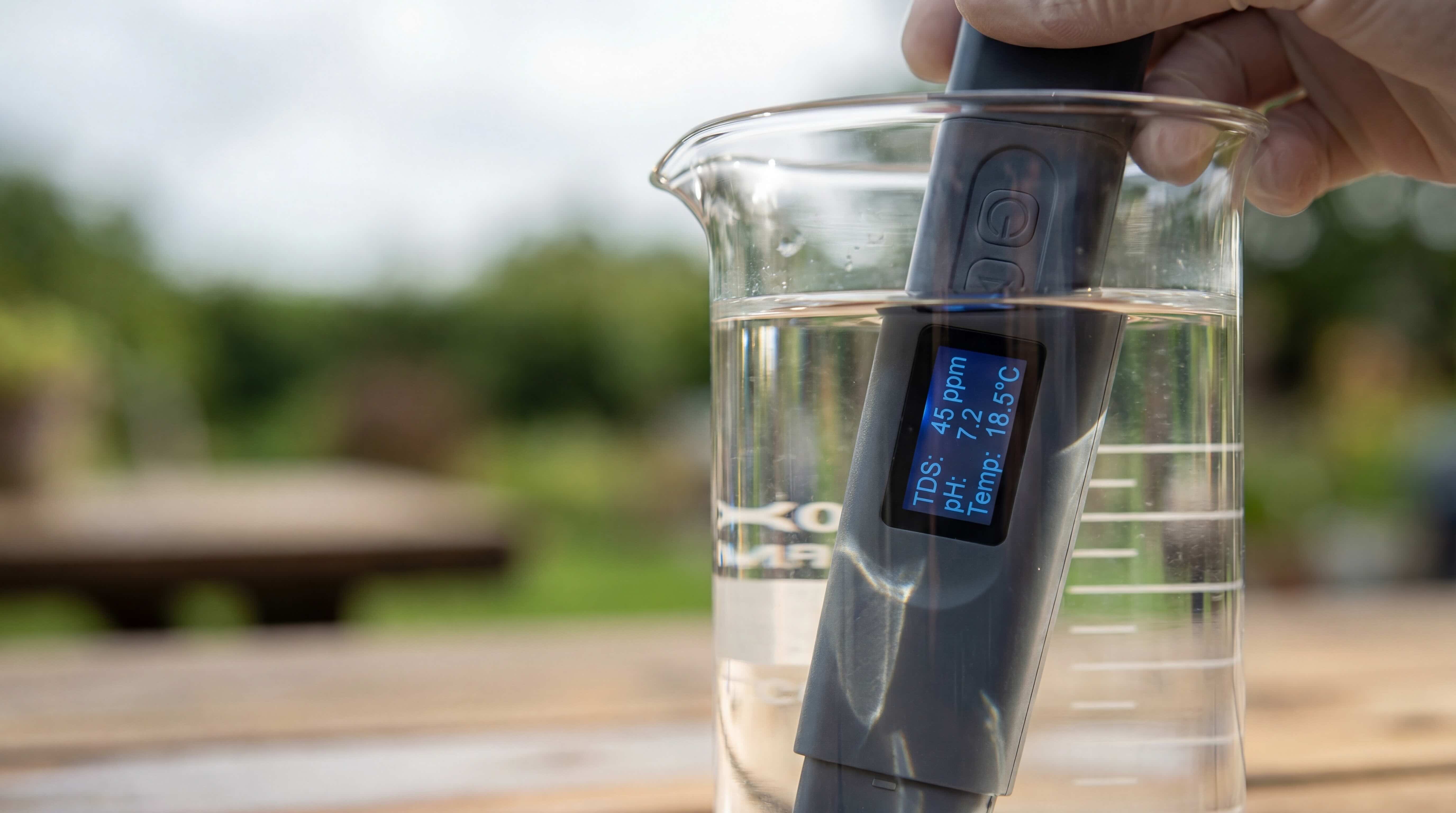
For many homeowners, installing a Reverse Osmosis (RO) system is a significant step toward ensuring family health and water quality. After the installation is complete, it is common to use a TDS (Total Dissolved Solids) meter to verify that the system is working. However, a frequent point of confusion arises when users of premium systems, specifically those equipped with a remineralization stage, notice that the TDS reading at the faucet is higher than expected.
If you have noticed this "rebound" in your TDS levels, your first instinct might be to worry that the system is not filtering correctly. In reality, this shift in the data is a measurable indicator of a high-functioning, sophisticated filtration process. To understand why a higher TDS reading can actually be a sign of better water, we must look at what TDS truly measures and how the remineralization process works.
1. Defining TDS: Quantity vs. Quality
To interpret your water test results accurately, it is essential to define what a TDS meter does and does not do. Total Dissolved Solids (TDS) refers to the combined content of all inorganic and organic substances dissolved in a liquid. This includes everything from beneficial minerals like calcium and magnesium to unwanted contaminants like heavy metals, salts, and nitrates.
The most important thing to remember is that a TDS meter is a quantitative tool, not a qualitative one. It measures the electrical conductivity of the water. Because pure H₂O is a poor conductor, the presence of dissolved ions increases that conductivity, resulting in a higher number on your meter.
Crucially, the meter cannot distinguish between a "harmful" dissolved solid and a "beneficial" one. It simply counts the total amount of particles present. Therefore, a low TDS reading indicates high purity, but a slightly higher TDS reading, when achieved through a controlled process, indicates the presence of intentional additions that improve the water's characteristics.
2. The Efficiency of the RO Membrane
The core of any RO system is the semi-permeable membrane. This stage is responsible for the heavy lifting of purification. By applying pressure to the water, the membrane forces H₂O molecules through microscopic pores while rejecting the vast majority of dissolved solids.
The result of this stage is highly purified, demineralized water. Because the membrane is so effective at removing almost all ions, the TDS level drops significantly. This water is excellent for many applications. However, because it has been stripped of its natural mineral content, it can be slightly acidic and might have a "flat" taste profile for some people. This is a natural physical outcome of high-precision filtration, and it serves as the perfect "blank canvas" for the final stage of your water treatment.
3. The Science of the Remineralization Process
In some RO systems, the water goes through an additional step after it has been purified: the remineralization filter. This stage is designed to introduce specific, healthy elements back into the water stream.
As the purified water flows through the remineralization media, which is typically composed of natural minerals like calcium and magnesium, a controlled ion exchange occurs. Because the RO process makes the water "hungry" for minerals, it naturally dissolves a small amount of the media as it passes through.
This process serves several vital functions:
-
pH Balancing: Purified water often has a lower pH. The introduction of minerals acts as a natural buffer, bringing the water closer to a neutral or slightly alkaline state.
-
Structural Stabilization: Minerals help stabilize the water, making it less "aggressive" and more balanced for consumption.
-
Measurable TDS Increase: Because calcium and magnesium are dissolved solids, their presence will naturally be detected by a TDS meter.
This increase in TDS is the physical proof that the remineralization filter is working. If the TDS did not rise after this stage, it would indicate that no minerals were being added to your water.
4. Why "Zero" Isn't the Only Standard for Drinking Water
There is a common misconception in the consumer market that "the lower the TDS, the better the water". While this is true for industrial applications such as laboratory work, car washes, or steam boilers where mineral buildup is an enemy, it is not necessarily the standard for high-quality drinking water.
In nature, some of the most sought-after spring waters in the world have significant TDS levels. This is because dissolved minerals provide what is known as "mouthfeel" and a refreshing flavor profile. Without these minerals, water can taste "hollow" or "sharp."
By utilizing a system that purifies the water first and then adds a precise amount of minerals back in, you are creating a "designer" water. You are removing the unknown and potentially harmful solids found in tap water and replacing them with a known, beneficial mineral profile. In this context, the rise in TDS is not a sign of "re-contamination," but rather a sign of "enrichment."
5. Interpreting Your Readings Accurately
To truly understand how your system is performing, it is helpful to look at the "TDS Journey" rather than just the final number at the faucet. A healthy, remineralizing RO system will show a specific pattern:
-
The Source Water: Your tap water will have a baseline TDS based on your local municipality’s supply.
-
The RO Tank: After the water passes through the RO membrane, the TDS should be at its lowest point. This confirms that the membrane is effectively rejecting contaminants.
-
The Final Output: As the water travels from the tank through the remineralization filter to your faucet, the TDS will rise.
The difference between the "Tank" reading and the "Faucet" reading is the exact measure of the minerals being added. This increase is a feature of the system's design, intended to provide a more balanced and palatable drinking experience. It is also worth noting that factors such as water temperature and "contact time" (how long the water has been sitting in the filter) can cause slight variations in these readings, which is a normal part of the chemical dissolution process.
Conclusion
Understanding your water quality requires looking past a single number on a screen. A TDS meter is a useful tool, but its data must be interpreted through the lens of your filtration system's design.
If you see your TDS levels rise after the remineralization stage, you can be confident that your system is performing its dual mission: removing the harmful substances you don't want and adding back the beneficial minerals you do. At the end of the day, a slightly higher TDS reading post-filter isn't just "normal", it's a sign of a system that is working to provide you with a more balanced, better-tasting glass of water.
Ready to enjoy the perfect balance of advanced purification and natural mineral taste? If you want a system that not only removes the bad stuff but also enriches your water with healthy minerals, explore our VIVA21 6-Stage Remineralization RO System. Give your family the benefit of high-purity, mineral-rich hydration right from your kitchen tap.


