

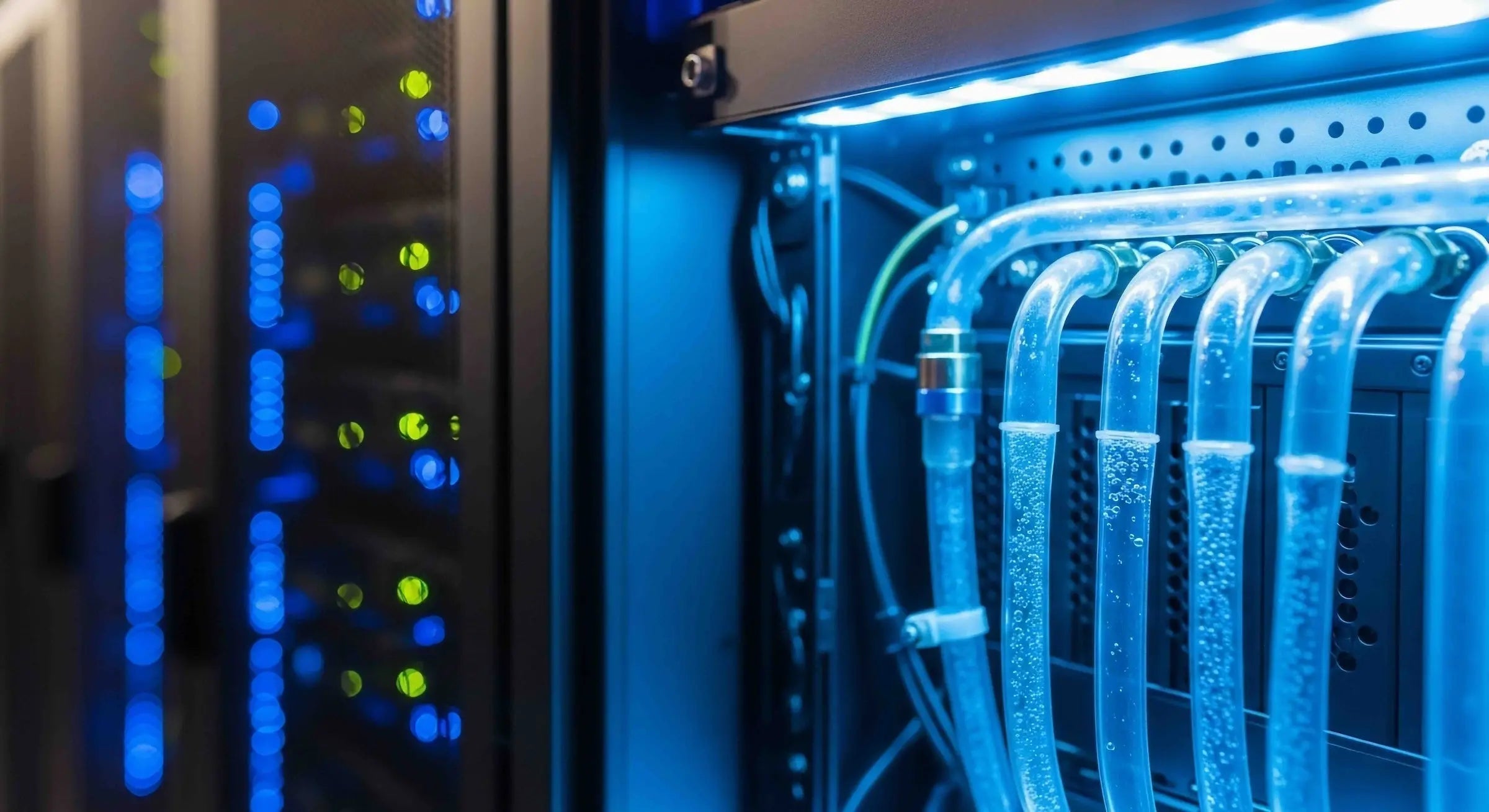
Artificial intelligence is transforming industries at an unprecedented pace, and behind every powerful AI model lies a silent challenge: heat management. Modern AI systems, with thousands of GPUs running at full capacity, generate enormous amounts of heat, far beyond what traditional air cooling can handle efficiently.
While innovations in hardware often take center stage, the quality of the liquid circulating through cooling systems plays a crucial, yet often overlooked, role. Understanding why filtered and treated water is essential helps explain the difference between water that is safe to drink and water that actually works in AI cooling loops.
1. Why Liquid Cooling Is Becoming Essential for AI Systems
AI workloads operate at extreme power densities. Training large models requires GPUs and specialized accelerators to run near maximum capacity around the clock. This generates far more heat per rack than air can reliably dissipate.
Air cooling has physical limits. Fans can move only so much heat, and air itself is not an efficient heat carrier. As rack density increases, air cooling alone becomes energy-intensive, noisy, and insufficient.
Liquid cooling is the backbone of the AI era because water captures and transfers heat far more efficiently than air, enabling higher thermal performance for high-density GPU racks. By replacing energy-intensive fan arrays with precise fluid loops, facilities can significantly reduce energy consumption and improve PUE (Power Usage Effectiveness). Most importantly, using a stable, engineered water medium prevents thermal throttling and hardware degradation, ensuring rock-solid system stability for continuous AI workloads.
This method offers high efficiency and consistent performance, but it also places stringent demands on the quality and predictability of the water in the system.
2. Key Water Requirements for AI Cooling Systems
To operate reliably over long periods of time, AI liquid cooling systems place strict demands on the quality and stability of the water circulating inside them. These requirements go far beyond basic safety or cleanliness and directly affect system performance, durability, and maintenance needs.
Cooling efficiency depends on the water’s purity and chemistry. TDS (total dissolved solids), silica, and gases like oxygen or carbon dioxide can build up deposits or accelerate corrosion, while water with fewer ions and higher resistivity flows more predictably and protects system components. Cooling water must meet several specific requirements:
Low mineral content
Cooling channels and cold plates used in AI systems are extremely narrow to maximize heat transfer. Even small amounts of dissolved minerals can slowly settle out of the water and form solid deposits on internal surfaces. Over time, these deposits reduce the ability of water to absorb and carry away heat, increase resistance to flow, and force pumps and components to work harder. What begins as a microscopic layer can eventually degrade cooling efficiency and contribute to local overheating.
Low and stable electrical conductivity
In a cooling loop, water is constantly in contact with different metals used in pipes, heat exchangers, and cold plates. If the water contains too many dissolved ions, it can carry electrical charges more easily, which increases the risk of metal degradation over time. This process does not happen suddenly but gradually weakens surfaces, creates rough internal areas, and releases corrosion byproducts that further contaminate the loop. Keeping conductivity low and consistent helps protect the system from slow, invisible damage.
Chemically predictable over time
AI cooling systems are designed to run continuously for months or years with minimal interruption. For this to be possible, the water’s chemical makeup must remain stable and predictable. If water chemistry changes over time, it can interfere with system balance, alter how materials behave, and make maintenance planning difficult. Stable water chemistry allows operators to design and run cooling systems with confidence that performance will not drift unexpectedly.
Biological stability
Warm, circulating water creates an environment where microorganisms can multiply if conditions allow. Once growth begins, biological buildup can coat internal surfaces, reduce heat transfer, block narrow channels, and contribute to unpleasant odors or system fouling. Preventing biological growth is essential not only for efficiency, but also for long-term reliability and reduced maintenance downtime.
Material compatibility
Cooling water must be compatible with every material it touches, including metals, seals, coatings, and flexible components. Certain substances in water can react slowly with these materials, causing discoloration, softening, brittleness, or corrosion. Over time, these reactions increase the risk of leaks, component failure, and costly repairs. Properly treated, high-purity water minimizes unexpected interactions and helps extend the lifespan of the entire cooling loop.
3. The Role of Filtered and Treated Water in Cooling Performance
What Direct-to-Chip Liquid Cooling Looks Like in Practice
In Direct-to-Chip systems, liquid flows through cold plates mounted directly on GPUs and CPUs. Heat is transferred from the chip into the liquid, which then circulates through a closed loop to release that heat elsewhere in the system.
This design delivers highly efficient and consistent cooling. However, it also places strict demands on the liquid itself. Unlike consumer electronics, these systems are expected to run continuously for years with minimal downtime. Even small changes in water chemistry can accumulate into serious long-term problems.
As a result, the choice of water becomes an engineering decision, not a convenience choice.
How Filtered Water Is Prepared for AI Cooling
To meet these requirements, many AI cooling systems start with reverse osmosis (RO) or deionized (DI) water. This highly purified water removes most dissolved minerals, salts, and impurities, creating a clean baseline with very low conductivity.
-
Reverse osmosis (RO) treatment: Water is pushed through semi-permeable membranes that remove most dissolved salts, organics, and particulates. A single-pass RO lowers conductivity to the low tens of µS/cm, while a double-pass RO can reduce dissolved solids even further, providing an extremely clean baseline for subsequent polishing and precise chemical control.
-
Deionization (DI) polishing: DI water is one of the most popular coolants used in the cold plate loop according to Open Compute Project (OCP). The treatment removes remaining ions using ion-exchange resins. This process produces very low-conductivity water suitable for sensitive closed-loop cooling systems. Unlike some chemical treatments, DI achieves high water purity without introducing additional reactive chemicals, helping maintain stable performance over time.
However, RO or DI water is rarely used “as is.” In Direct-to-Chip cooling loops, it undergoes careful further engineering to ensure long-term performance:
-
pH stabilization: RO and DI water can absorb carbon dioxide from the air, becoming slightly acidic. While this mild acidity alone is usually not the primary cause of corrosion, engineers stabilize the pH to prevent material stress and avoid accelerating chemical reactions with metals. This ensures that the water remains compatible with copper, aluminum, and steel components throughout continuous operation.
-
Corrosion inhibitors: Specialized additives are introduced selectively to protect metal surfaces from electrochemical reactions. These inhibitors are carefully controlled to maintain low conductivity, preventing the very ions that drive corrosion while avoiding negative impacts on heat transfer efficiency.
-
Additive and chemical consistency control: Beyond pH and inhibitors, the water is continuously engineered to maintain stable chemistry over time. This includes controlling trace elements, dissolved gases, and other factors that could fluctuate in raw RO/DI water. The result is a predictable, high-performance cooling medium that supports reliable heat removal over years of continuous operation.
In essence, engineered cooling water transforms RO/DI water from a raw, reactive medium into a controlled, high-performance coolant optimized for AI hardware.
4. How High-Purity Water Improves Cooling Performance
Highly purified water keeps AI cooling loops running efficiently by preventing scale and deposits on cold plates, heat exchangers, and piping. Clean surfaces maintain effective heat transfer, allowing pumps and chillers to operate closer to design specifications with less energy. Stable water chemistry also preserves consistent flow and pressure over time, reducing maintenance and avoiding performance drift. Fewer corrosion and fouling issues extend the lifespan of system components and support higher rack densities, while minimizing energy and water consumption.All of these are contributing to more reliable, predictable cooling for demanding AI workloads.
Conclusion
Liquid cooling allows AI systems to achieve the performance required for modern workloads. But cooling works only as well as the water circulating inside the system.
Filtered and treated water, often starts with RO or DI purification and further engineered for stability, provides a reliable, predictable foundation for Direct-to-Chip liquid cooling loops. It prevents scale, reduces corrosion, and ensures reliable heat transfer over the long term.
For humans, water quality is about taste and safety. For AI systems, water quality is about performance, stability, and control. In the era of AI, that difference is critical.


