

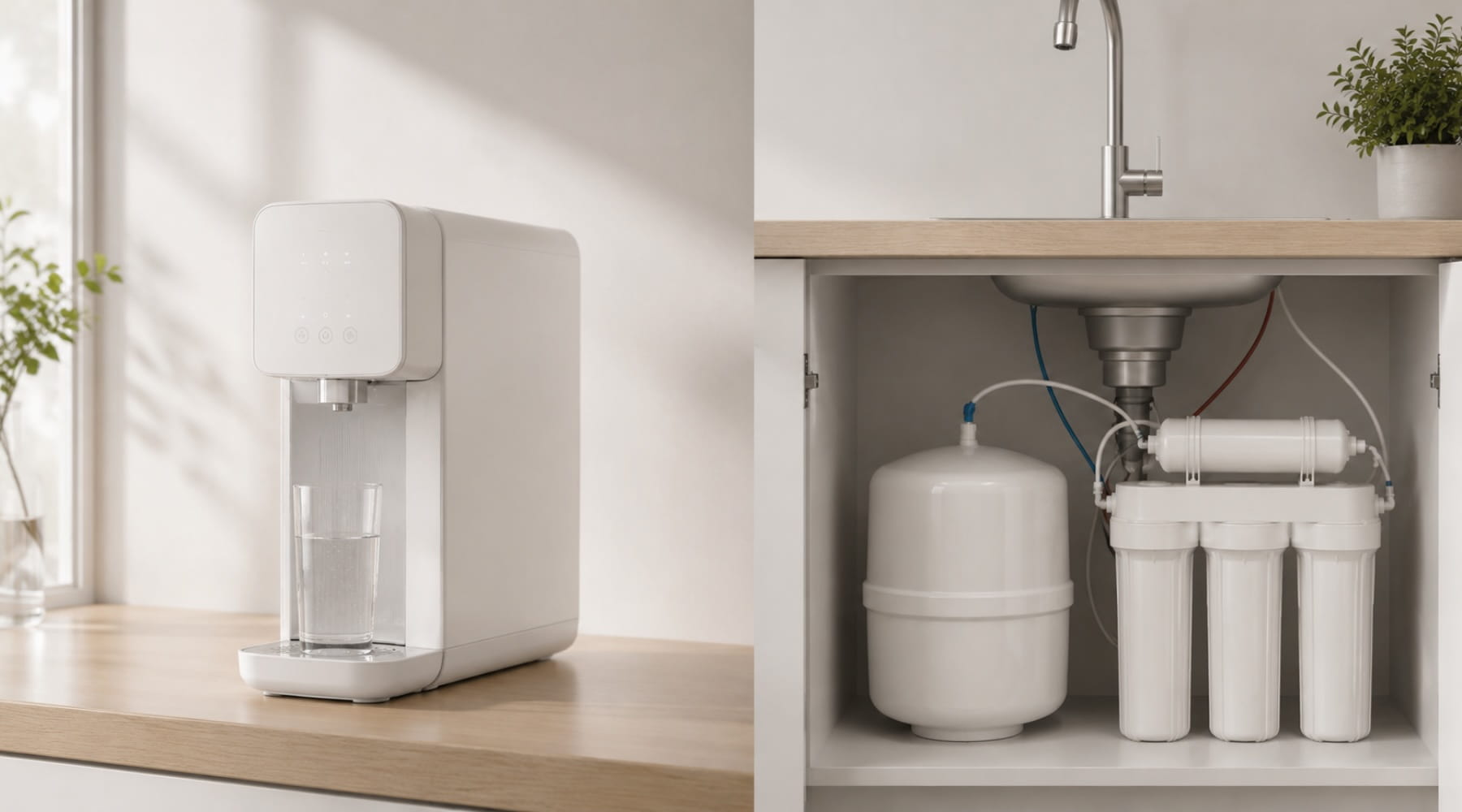
Living in an apartment shouldn’t mean compromising on the quality of your drinking water. Whether you are dealing with chloramines, heavy metals, or simply the unpleasant taste of municipal tap water, a Reverse Osmosis (RO) system is the gold standard for purification.
However, as a renter, you face a unique set of constraints. You have limited space, strict lease agreements, and the reality that you will eventually have to pack up and move.
When shopping for an RO system, the choice inevitably boils down to two main configurations: Countertop RO systems and Under-Sink RO systems. Both deliver exceptionally pure, bottled-water-quality water, but they suit entirely different living situations.
This guide will show you the science, the installation practicalities, and the long-term costs to help you decide which system is the best investment for your apartment.
How Do They Compare in Purification?
Before looking at the design differences, it is important to understand that both systems use the exact same fundamental technology.
Reverse osmosis works by forcing pressurized water through a semipermeable membrane with microscopic pores (typically around 0.0001 microns). This physical barrier removes up to 99% of dissolved solids (TDS), including lead, fluoride, arsenic, microplastics, and chlorine byproducts.
Whether you choose a countertop unit or an under-sink installation, the filtration efficacy is virtually identical, provided you use high-quality, multi-stage filters. The real difference lies in how water enters the system, how it is stored, and how it is delivered to your glass.
Option 1: Countertop RO Systems (The Portable Solution)
Countertop RO systems are freestanding appliances that sit directly on your counter. Most modern countertop units are tankless and plug-and-play, requiring zero connection to your apartment's plumbing. You simply fill a removable source water tank at the sink, place it back on the unit, and the system filters the water into an internal carafe or dispenses it on demand.
The Pros:
-
Zero Installation & Damage-Free: There is absolutely no drilling, plumbing modifications, or risk of water leaks behind the walls. You can unbox the unit and have pure water in under five minutes.
-
100% Renter-Friendly: Because it does not modify the property, you have zero risk of losing your security deposit due to plumbing alterations.
-
Extreme Portability: When your lease is up, you simply empty the water, pack the unit into a box, and take it to your next home.
-
Smart Features: Many premium countertop RO purifiers feature instant heating options, allowing you to dispense hot water for tea, coffee, or baby formula at the touch of a button.
The Cons:
-
Sacrifices Counter Space: If you have a tiny kitchen with minimal prep space, dedicating a footprint to a countertop appliance can feel restrictive.
-
Manual Refilling: Since these units are not connected to a continuous water line, you must manually refill the feed-water tank and empty the concentrated waste-water tank.
-
Lower Daily Output: Because they rely on manual refills, they are best suited for individuals, couples, or small families rather than high-volume households.
Option 2: Under-Sink RO Systems (The Seamless, High-Volume Powerhouse)
Under-sink RO systems are installed inside the cabinet beneath your sink. They connect directly to your cold-water line, divert a portion of the water through the filtration stages, and deliver pure water through a dedicated auxiliary faucet mounted on your sink.
The Pros:
-
Clutter-Free Kitchens: The entire filtration apparatus, including filters, membranes, and connections, is completely hidden away out of sight.
-
Continuous, On-Demand Water: Connected directly to your plumbing, these systems offer a continuous supply of purified water. There are no reservoirs to manually refill.
-
Higher Flow Rates: Under-sink systems typically deliver water much faster than countertop counterparts, making them ideal for cooking, filling large pots, and serving larger households.
-
Longer Filter Lifespans: Because under-sink cartridges are physically larger, they often require less frequent replacements than the compact filters found in countertop units.
The Cons:
-
Complex Installation: Installing an under-sink system requires tapping into your cold-water line and connecting a wastewater drain saddle to your sink’s drainpipe.
-
The "Faucet Hole": Under-sink systems require a dedicated faucet. If your rental sink does not have an existing, unused hole (such as a pre-drilled hole for a soap dispenser or sprayer), you will have to drill a hole through the countertop or sink basin, which is a modification most landlords strictly prohibit.
-
Moving Hassles: Uninstalling the system, restoring the original plumbing connections, and patching up the system when you move out is a time-consuming process.
Head-to-Head: Countertop vs. Under-Sink RO
|
Feature |
Countertop RO Systems |
Under-Sink RO Systems |
|
Installation Difficulty |
None (Plug & Play) |
Moderate (Requires plumbing access) |
|
Plumbing Modifications |
None |
Yes (Tapping cold water line & drain) |
|
Portability |
Excellent (Pack and go) |
Low (Requires uninstallation & restoration) |
|
Counter Space Needed |
Moderate footprint |
None (Hidden under the cabinet) |
|
Water Supply |
Manual refill tank |
Continuous (Direct from water line) |
|
Best Suited For |
Studio apartments, frequent movers |
Long-term renters, large families |
Key Decision Factors for Apartment Renters
To determine which setup is right for your current living situation, ask yourself these three critical questions:
1. What does your lease agreement say?
Read your lease carefully. Many property management companies have strict "no plumbing modifications" clauses. If your landlord conducting a routine inspection finds unauthorized connections under the sink, it could lead to lease violations. If you want a completely stress-free tenancy, a countertop RO system is the safest bet.
2. Does your sink have an extra prep hole?
Look at your kitchen sink. If there is a plastic cap covering an extra hole, or a soap dispenser you are willing to temporarily remove, you can install an under-sink faucet without drilling. If you have solid granite, quartz, or marble countertops with no extra holes, drilling is a hard "no-go" for renters, making a countertop water purifier your only viable option.
3. How long do you plan to stay?
If you are on a short-term lease or plan to move within the next 12 to 18 months, the effort of installing and uninstalling an under-sink system is rarely worth it. However, if you have signed a multi-year lease and value having a completely clear countertop, the one-time setup of an under-sink unit is a highly rewarding investment.
The Verdict
There is no single "best" system, only the system that aligns with your space, your lifestyle, and your lease agreement.
-
Choose a Countertop RO System if: You rent a small apartment, move frequently, want a stress-free setup with zero plumbing risks, or love the convenience of instant hot water dispensing.
-
Choose an Under-Sink RO System if: You have a long-term lease, a busy household that uses lots of water for both drinking and cooking, and a sink setup that allows for a dedicated faucet without drilling new holes.
Both paths lead to the same destination: clean, delicious, contaminant-free water right at home. Take a look at your kitchen layout, review your lease, and choose the system that makes drinking healthy water effortless.


