

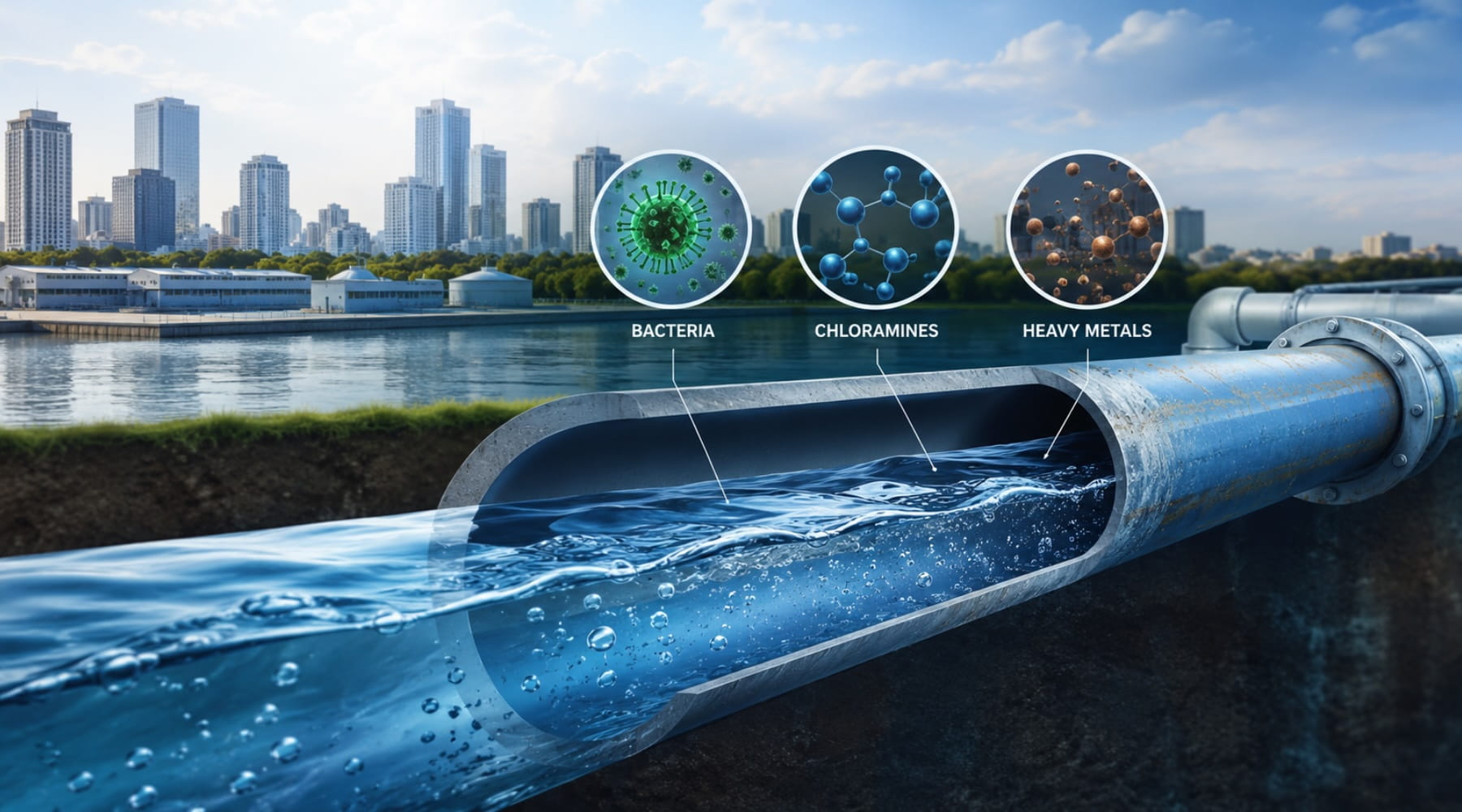
If you have noticed a persistent, swimming-pool-like smell in your drinking water, even after passing it through a standard pitcher filter, you are likely dealing with chloramines.
Over the last few decades, thousands of municipal water treatment facilities across the globe have quietly shifted their disinfection methods. While traditional chlorine was once the gold standard for keeping public water safe from pathogens, many cities have transitioned to a more persistent alternative: chloramines.
But what exactly are chloramines, how do they affect your health and home, and what is the most effective way to remove them? In this guide, we will talk about chloramines and explore the most reliable filtration technologies to ensure your family enjoys truly clean, great-tasting water.
Chlorine vs. Chloramines: What Is the Difference?
To understand how to remove chloramines from tap water, it helps to understand what they are.
-
Chlorine is a highly reactive gas. When added to water, it quickly neutralizes bacteria and viruses. However, because it is so reactive, it dissipates rapidly into the air. This means water traveling to the very end of a city’s pipeline might lose its protective disinfection.
-
Chloramines are chemical compounds formed by mixing chlorine with ammonia. The most common form used in water treatment is monochloramine.
Unlike free chlorine, chloramines are incredibly stable. They do not evaporate easily and remain active in the water distribution system for a long time. While this stability is a major benefit for municipal water plants, it presents a massive challenge for home water filtration. Because chloramines do not break down easily, standard carbon filters that easily remove chlorine often fail to eliminate chloramines.
Why Are Chloramines Used in Municipal Water?
Water treatment plants prefer chloramines for two primary reasons:
-
Long-Lasting Disinfection: Because they break down slowly, chloramines protect the municipal water supply all the way from the treatment plant to your kitchen tap.
-
Fewer Disinfection Byproducts (DBPs): When free chlorine reacts with natural organic matter in water, it can create harmful, regulated byproducts like trihalomethanes (THMs), which are linked to long-term health risks. Chloramines produce significantly fewer of these specific byproducts.
Despite these operational advantages, chloramines are far from ideal by the time they reach your glass.
Are Chloramines in Drinking Water Safe?
According to the EPA, drinking water with chloramine levels up to 4 milligrams per liter is considered safe for human consumption. However, "safe" does not necessarily mean desirable. Many homeowners choose to remove chloramines due to several key concerns:
-
Taste and Odor: Chloramines give tap water a distinct chemical taste and a strong, unpleasant odor that can ruin the flavor of coffee, tea, and home-cooked meals.
-
Skin and Eye Irritation: Showering in chloraminated water can strip natural oils from your skin and hair, leading to eczema flare-ups, dry skin, and itchy, red eyes.
-
Corrosiveness to Plumbing: Chloramines are highly corrosive. They can degrade copper pipes, lead solder, and rubber plumbing components (such as toilet flappers and water heater gaskets) over time, potentially leading to costly leaks or heavy metal leaching.
-
Toxicity to Pets and Aquariums: While humans can metabolize small amounts of chloramines, they are highly toxic to fish, reptiles, and amphibians because the chemical enters their bloodstream directly through their gills or skin.
Why Standard Carbon Pitchers Fall Short
Many people assume that a basic, store-bought carbon pitcher filter is enough to clean their tap water. While these simple filters can reduce free chlorine, they are largely ineffective against chloramines.
Removing chloramines requires breaking the strong chemical bond between the chlorine and ammonia molecules. Standard Granular Activated Carbon (GAC) removes contaminants through adsorption. Because the chloramine bond is so stable, water must stay in contact with the carbon for an exceptionally long time (known as "contact time") to break it down. In a typical pitcher filter where water flows quickly through a tiny amount of carbon, chloramines simply pass right through.
How to Remove Chloramines from Tap Water: The Multi-Stage RO Solution
To effectively eliminate chloramines from your drinking water, you need a system that overcomes the "contact time" challenge. This is where a multi-stage Reverse Osmosis (RO) system combined with high-capacity activated carbon filters becomes the gold standard for home water purification.
An RO system does not rely on a single filter. Instead, it uses a strategic, multi-stage process to systematically dismantle and remove chloramines:
1. High-Density Activated Carbon Pre-Filtration (Stages 1 & 2)
Before the water even reaches the RO membrane, it passes through specialized, high-density activated carbon block filters.
-
The Contact Time Advantage: An under-sink RO system processes water at a controlled, systematic pace. This significantly increases the contact time between the water and the activated carbon.
-
Breaking the Bond: This prolonged contact allows the premium activated carbon to successfully break the stubborn chloramine bond, trapping the chlorine component and freeing the remaining ammonia.
2. The Advanced Reverse Osmosis Membrane (Stage 3)
Once the activated carbon pre-filter has broken the chloramine chemical bond, the water is forced through a semi-permeable RO membrane with microscopic pores (0.0001 microns). The RO membrane easily rejects the separated ammonia ions, flushing them away along with up to 99% of other contaminants like heavy metals, fluoride, lead, and microplastics.
3. Activated Carbon Post-Filtration (Stage 4)
Finally, the water passes through a post-activated carbon filter. This final stage acts as a polishing filter, capturing any remaining trace tastes or odors and ensuring your water flows into your glass with a crisp, refreshing, and completely pure taste.
Finding the Best Water Filter for Chloramines
If you are ready to upgrade your home’s water quality, keep these key factors in mind before you buy:
-
Choose Multi-Stage Systems: Look for a system that combines both high-capacity activated carbon blocks and an RO membrane. This combination is essential for handling complex municipal disinfectants like chloramines.
-
Look for Certified Performance: Ensure the system you choose is tested to rigorous industry standards (such as NSF/ANSI Standard 58 for reverse osmosis systems) to guarantee reliable contaminant reduction.
-
Consider an Under-Sink RO System: An under-sink reverse osmosis system is the most convenient way to secure a continuous supply of purified water for drinking, ice makers, and cooking without taking up valuable counter space.
-
Check Maintenance Requirements: Look for systems with twist-and-lock, easy-to-replace filter cartridges so you can maintain peak performance year after year without needing to hire a plumber.
Upgrade Your Water Quality Today
While municipal water treatment keeps water safe from bacteria, you do not have to settle for the chemical taste, odor, and potential plumbing damage caused by chloramines. Short-contact pitcher filters cannot solve the problem, but a dedicated home purification system can.
Investing in a multi-stage system is an investment in your family’s health, your home’s plumbing, and the daily enjoyment of your food and beverages.
Explore our Premium WQA-Certified Reverse Osmosis Water Purifier. Equipped with high-capacity activated carbon filtration and advanced RO membranes, our systems are engineered to bring pristine, chemical-free water straight to your home.


