Installing a Reverse Osmosis (RO) system under your kitchen sink is one of the single best investments you can make for your home’s drinking water. You get crisp, fresh-tasting water on demand without relying on single-use plastic bottles. But months after installation, a quiet question usually pops up in the back of your mind: Is my RO system still actually purifying my water as effectively as the day I bought it?
Because microscopic contaminants like nitrates, lead, arsenic, and dissolved salts are completely invisible and odorless, you can’t rely on sight or taste alone to judge your system’s performance.
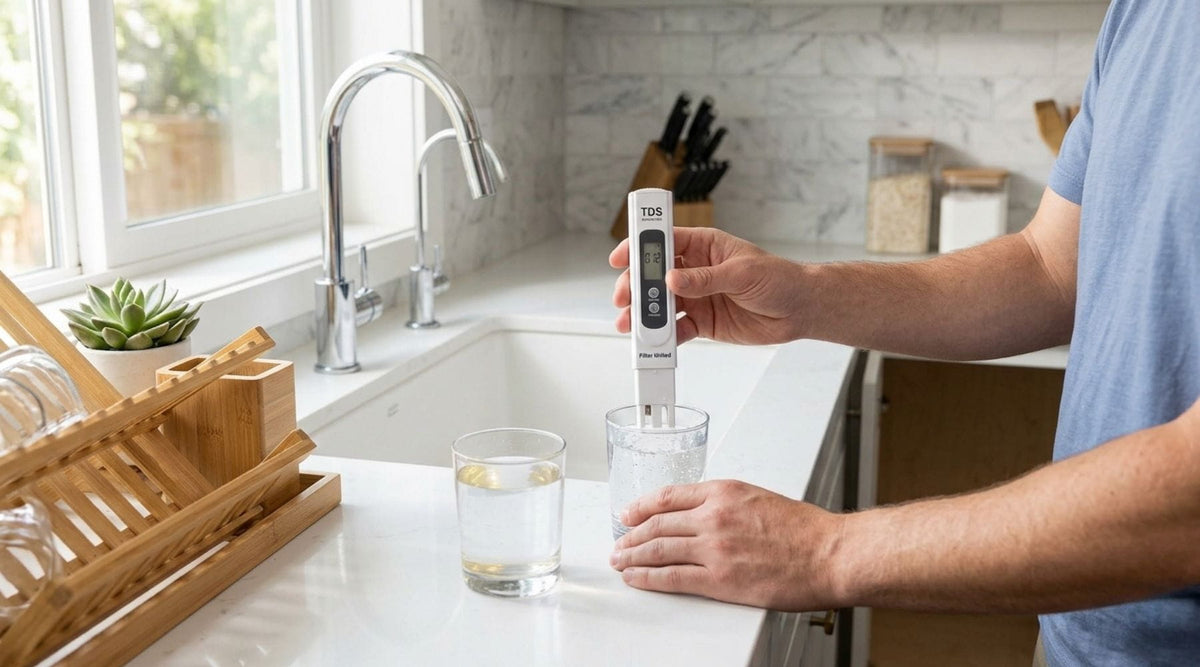
Fortunately, you don't need a degree in water chemistry or an expensive laboratory test to check on your system. With a low-cost, handheld Total Dissolved Solids (TDS) meter and two minutes of simple math, you can calculate your system’s rejection rate right at home.
In this guide, we will walk you through what an RO rejection rate is, why it matters, how to calculate it step-by-step, and what your final numbers reveal about the health of your water filtration system.
What Is an RO Rejection Rate (and Why Does It Matter)?
When water enters your Reverse Osmosis system, it passes through pre-filters before being forced through a semi-permeable membrane under pressure. This membrane features microscopic pores—roughly 0.0001 microns in size—that allow pure water molecules to pass through while trapping and flushing away dissolved minerals, heavy metals, and chemicals.
The rejection rate represents the percentage of Total Dissolved Solids (TDS) that your RO membrane successfully blocks from reaching your glass.
Key Concept:
-
Rejection Rate: The percentage of contaminants stripped out by the membrane.
-
Recovery Rate: The ratio of purified water produced compared to waste water sent down the drain.
For residential drinking water systems, rejection rate is the ultimate health metric. A brand-new, high-efficiency RO system, such as those engineered by Filter United, typically operates at a 95% to 99% rejection rate.
According to the Water Quality Association (WQA) and standards set under NSF/ANSI 58 (the benchmark standard for reverse osmosis drinking water treatment), a healthy residential RO membrane should consistently reject at least 90% of incoming dissolved solids. If your rejection rate falls below 85%–90%, it’s a clear indicator that your membrane has degraded, fouled, or ruptured, allowing dissolved minerals and impurities to slip into your drinking supply.
What You Need Before You Start
Testing your system requires minimal gear. Gather the following items before taking your measurements:
-
A Handheld Digital TDS Meter: Digital TDS meters are widely available online for under $15. They measure electrical conductivity in parts per million (ppm) or milligrams per liter (mg/L).
-
Two Clean Glasses: Use clean, residue-free glass or ceramic cups. Avoid washed glasses with lingering soap film, as dried dish detergent will artificially inflate your TDS readings.
-
A Notepad or Smartphone: To jot down your two numbers.
Crucial Pre-Test Warning: Mind "TDS Creep"
Before pulling out your TDS meter, there is one technical nuance that trips up many homeowners: TDS Creep.
When your RO system sits idle between uses, water remains stationary inside the membrane housing. Over several hours, dissolved minerals slowly diffuse across the membrane from the tap water side to the purified water side until concentrations equalize slightly.
If you turn on your RO faucet and test the very first cup of water that comes out, you will almost certainly get an artificially high TDS reading. This doesn't mean your membrane is broken, it's simply a natural physical phenomenon known as TDS creep.
How to eliminate TDS creep during testing:
Turn on your RO faucet and let the water run for 30 to 60 seconds before collecting your sample. This flushes out the stagnant water sitting in the housing and ensures you are testing freshly filtered water straight from the active membrane.
Step-by-Step Guide: How to Measure Your Rejection Rate
Testing your rejection rate involves taking two simple measurements and comparing them.
Step 1: Collect and Test Your Raw Tap Water (TDStap)
-
Turn on your kitchen cold water tap and let it run for 15 seconds.
-
Fill a clean glass halfway with tap water.
-
Turn on your handheld TDS meter, submerge the metal probes into the water (do not submerge the whole meter!), and gently swirl for 5 seconds to remove air bubbles.
-
Wait for the digital display to stabilize, then record the number. This is your Raw Tap Water TDS (TDStap).
Step 2: Collect and Test Your Purified RO Water (TDSro)
-
Let your dedicated RO faucet run for 45–60 seconds to purge any stagnant water.
-
Rinse your second clean glass with a small amount of RO water, dump it out, and then fill the glass halfway.
-
Dip your clean TDS meter into the RO sample, swirl gently, and wait for the reading to stabilize.
-
Record this number. This is your RO Purified Water TDS (TDSro).
The Math: Calculating Your RO System's Efficiency
Now that you have your two numbers, plug them into the standard industry rejection rate formula:
Rejection Rate (%) = TDStap-TDSroTDStap100%
Let’s look at two real-world examples to see how this works in practice.
Example A: A Healthy, High-Efficiency System
-
Tap Water TDS (TDStap): 320 ppm
-
RO Water TDS (TDSro): 12 ppm
Rejection Rate=(320−12)/330×100%=(308/320)×100%=96.25%
Verdict: Excellent performance. The system is blocking over 96% of all dissolved solids, well above industry standards.
Example B: An Aging or Compromised Membrane
-
Tap Water TDS (TDStap): 280 ppm
-
RO Water TDS (TDSro): 45 ppm
Rejection Rate=(280−45)/280×100%=(235/280)×100%=83.9%
Verdict: Time for maintenance. A rejection rate under 85% indicates that the membrane is degrading and passing unnecessary dissolved impurities into your drinking water.
How to Interpret Your Results
Use this reference table to evaluate the overall performance of your reverse osmosis system:
|
Rejection Rate |
Performance Level |
Recommended Action |
|
95% – 99%+ |
Optimal |
Your system is working at peak efficiency. No action needed. |
|
90% – 94% |
Good |
Standard operating range. Continue routine testing every 3–6 months. |
|
85% – 89% |
Fair / Marginal |
The membrane is aging. Plan to inspect pre-filters and replace the membrane soon. |
|
Below 85% |
Poor |
The membrane is compromised or fouled. Replace membrane and pre-filters immediately. |
Note on Remineralized Water: If your RO system includes an alkaline remineralization filter after the membrane (which adds beneficial minerals like calcium and magnesium back into the purified water), take your RO sample before the remineralization stage if possible, or keep in mind that remineralizers naturally raise TDS to improve taste and pH.
What Causes a Drop in Rejection Rate?
If your calculation revealed a rejection rate lower than expected, don't panic. A drop in efficiency usually boils down to one of four common factors:
1. Exhausted Pre-Filters
RO membranes are protected by sediment and carbon pre-filters. If carbon pre-filters become saturated, chlorine and chloramines from municipal tap water can pass through and chemically burn holes into thin-film composite (TFC) membranes, permanently destroying their filtration capabilities. Pre-filters should generally be swapped every 6 to 12 months.
2. Low Water Pressure
Reverse osmosis relies on physical pressure to force water through the membrane while leaving contaminants behind. According to industry guidelines, standard residential RO membranes require incoming water pressure between 40 PSI and 80 PSI to function properly. If your municipal supply or well pump provides less than 40 PSI, the rejection rate drops significantly, and wastewater increases. Installing a booster pump can immediately restore system efficiency.
3. Membrane Fouling or Scaling
Over time, hard water minerals (calcium and magnesium) or biological biofilms can coat the surface of the membrane. This reduces water production and allows salt passage to rise.
4. Extreme Water Temperature
TDS meters and RO membranes are calibrated around room temperature (~77°F or 25°C). Very cold winter water contracts the pores in the membrane and increases viscosity, reducing flow and altering filtration performance slightly.
Maintaining Long-Term Pure Water Confidence
Checking your RO system's rejection rate manually takes less than five minutes, but doing it twice a year provides invaluable peace of mind. By keeping a quick log of your tap and RO TDS readings, you can spot performance dips before they impact your family's health or drink quality.
At Filter United, we believe every household deserves total clarity about what comes out of their tap. Whether you are running a high-output tankless system or a classic under-sink filtration setup, proactive monitoring combined with timely filter replacements ensures your home hydration remains clean, reliable, and refreshing for years to come.


