

Maintaining a home water purification system is one of the most proactive steps you can take for your family’s health. However, simply installing the best reverse osmosis system is not a "set-it-and-forget-it" solution. Over time, the heart of your system—the Reverse Osmosis (RO) membrane—will naturally wear down, leading to a decline in water quality.
So, how do you know when it is time for an under-sink RO membrane replacement, and how can you tell if your current system is still performing at its peak?
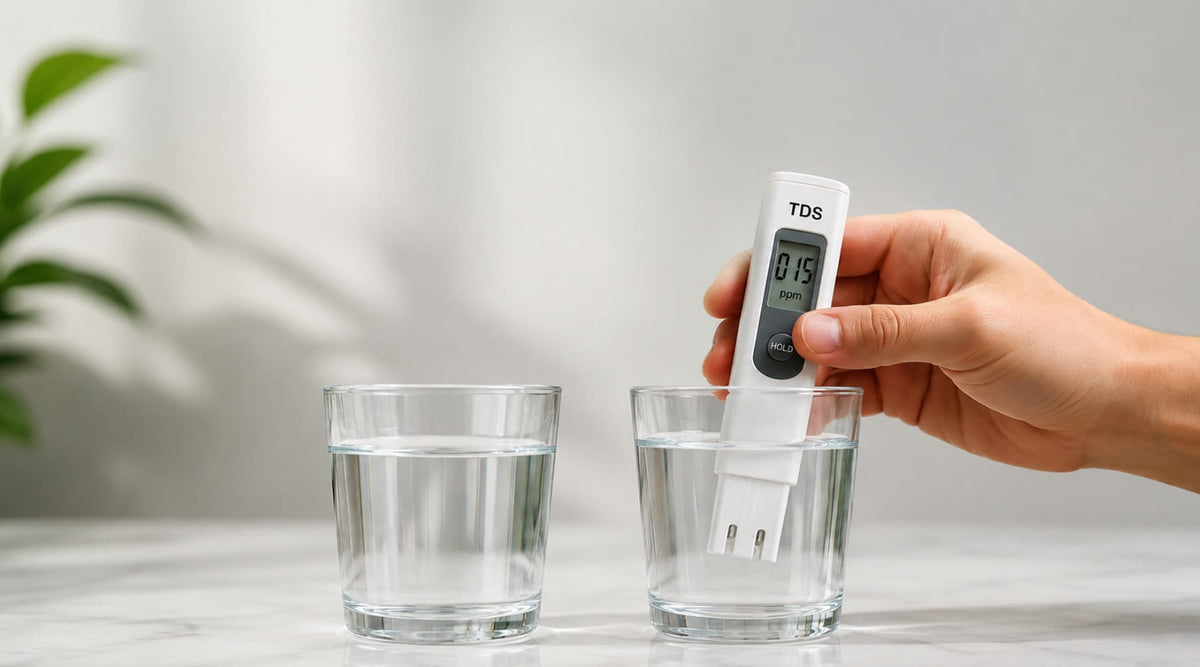
The most reliable, scientific, and cost-effective way to find out is by using a TDS (Total Dissolved Solids) meter. In this blog, we will go through exactly how a TDS meter works, how to measure your system's performance using a simple mathematical formula, and when you should buy replacement RO filters to keep your drinking water pristine.
What is TDS and Why Does It Matter for Reverse Osmosis?
Before diving into the testing process, it is important to understand what we are measuring. TDS stands for Total Dissolved Solids, which refers to the inorganic salts and small amounts of organic matter dissolved in water. These typically include:
-
Positive Ions (Cations): Calcium, Magnesium, Sodium, and Potassium.
-
Negative Ions (Anions): Carbonates, Nitrates, Chlorides, and Sulfates.
A digital TDS meter measures the electrical conductivity of the water and converts that reading into parts per million (ppm).
The Limits of a TDS Meter: An Honest Overview
While a TDS meter is an exceptional tool for monitoring the physical performance of an RO membrane, it is important to remain objective about its capabilities. A TDS meter does not measure water safety on its own. It cannot detect uncharged contaminants such as bacteria, viruses, volatile organic compounds (VOCs), pesticides, or certain heavy metals.
Instead, a TDS meter acts as a direct report card for your RO membrane's physical integrity. When an RO membrane is functioning correctly, it should reject the vast majority of dissolved minerals. If those minerals are slipping through, it is a clear indicator that the microscopic pores of the membrane have stretched or degraded.
Step-by-Step Guide: How to Test Your RO Membrane with a TDS Meter
To get a highly accurate reading, you cannot just test the water coming out of your purified tap. You need a baseline for comparison. Follow these precise steps to measure your system’s actual filtration performance.
Step 1: Gather Your Tools
-
A calibrated digital TDS meter.
-
Two clean, dry glass cups (avoid plastic cups, as they can sometimes hold static charges or residue that alters the reading).
Step 2: Test the Feed Water (Your Tap Water)
-
Run your cold water tap for about 30 seconds to ensure you are getting fresh water from the main water line.
-
Fill the first clean glass with this tap water.
-
Turn on your TDS meter (ensuring the screen reads 000).
-
Submerge the metal prongs of the meter about an inch into the water. Do not submerge the entire meter.
-
Lightly stir the meter to remove any trapped air bubbles on the prongs.
-
Once the digital reading stabilizes, write down the number. This is your Feed Water TDS (Tap TDS).
Step 3: Flush the System to Avoid "TDS Creep"
When an RO system sits idle for a few hours, a small amount of dissolved solids naturally migrate across the membrane in a phenomenon known as "TDS Creep". If you test the very first cup of water that comes out of your RO faucet, your reading will be artificially high.
-
Action: Turn on your RO faucet and let the water run for 30 to 60 seconds before collecting a sample. This flushes out any standing water and ensures you are testing freshly filtered water.
Step 4: Test the Purified RO Water
-
Rinse your second glass with a small amount of the running RO water, discard it, and then fill the glass.
-
Rinse the tip of your TDS meter in clean RO water to prevent cross-contamination from the tap water test.
-
Insert the meter into the RO water sample, stir gently, and record the stabilized number. This is your Product Water TDS (RO TDS).
Calculating Your Membrane’s Rejection Rate
An RO membrane does not need to bring your TDS down to absolute zero to be considered healthy. In fact, a healthy membrane typically removes 90% to 99% of all dissolved solids.
To determine if your membrane is performing up to industry standards, use the following Salt Rejection Formula:
Rejection Rate (%) = Feed TDS - RO TDSFeed TDS 100
Example Calculation
Let’s say your tap water tested at 300 ppm, and your purified RO water tested at 15 ppm:
Rejection Rate=(300−15)/300×100=285/300×100=95%
At 95% rejection, your reverse osmosis membrane is in excellent condition and operating perfectly within factory specifications.
Interpreting Your TDS Results
Use this quick-reference table to understand what your calculated rejection rate means for your system:
|
Rejection Rate |
Membrane Status |
Recommended Action |
|
90% – 99% |
Excellent |
No action needed. Your membrane is highly effective. |
|
80% – 89% |
Acceptable (Marginal) |
Monitor closely. Check if pre-filters need replacement. |
|
Below 80% |
Failing |
Time to buy replacement RO filters and a new membrane. |
Note: If you have recently installed new carbon pre-filters or post-filters, you may notice a temporary spike in TDS for the first 24 to 48 hours. This is completely normal and is caused by harmless carbon "fines" (micro-dust) rinsing out of the new cartridges. Always wait a few days after a filter change to run an official TDS membrane test.
When to Buy Replacement RO Filters vs. a New RO Membrane
A common point of confusion for homeowners is deciding whether to replace the pre-filters or the RO membrane itself. They operate on very different lifespans:
-
Sediment & Carbon Pre-Filters: These protect the delicate RO membrane by removing chlorine, rust, sand, and larger sediment. They should typically be replaced every 6 to 12 months. If you neglect these, chlorine will slip through and permanently chemically damage your RO membrane.
-
The RO Membrane: Because it performs the finest level of molecular separation, a high-quality RO membrane typically lasts between 2 to 3 years, depending on your local water hardness and daily usage.
If your TDS rejection rate drops below 80%, replacing only the pre-filters will not restore your water quality, you will need an under-sink RO membrane replacement to restore your system's purifying power.
Keep Your Water Pure
A digital TDS meter is a small, inexpensive investment that takes the guesswork out of maintaining your water quality. By performing this simple test twice a year, you can ensure your family is always drinking truly purified water while avoiding the unnecessary cost of replacing an RO membrane before its time.
If your recent TDS test indicated that your system's rejection rate is slipping, do not wait until your water taste degrades. Explore our curated selection of WQA-Certified Reverse Osmosis System and high-performance replacement RO filters to restore your home's water purity today.


