

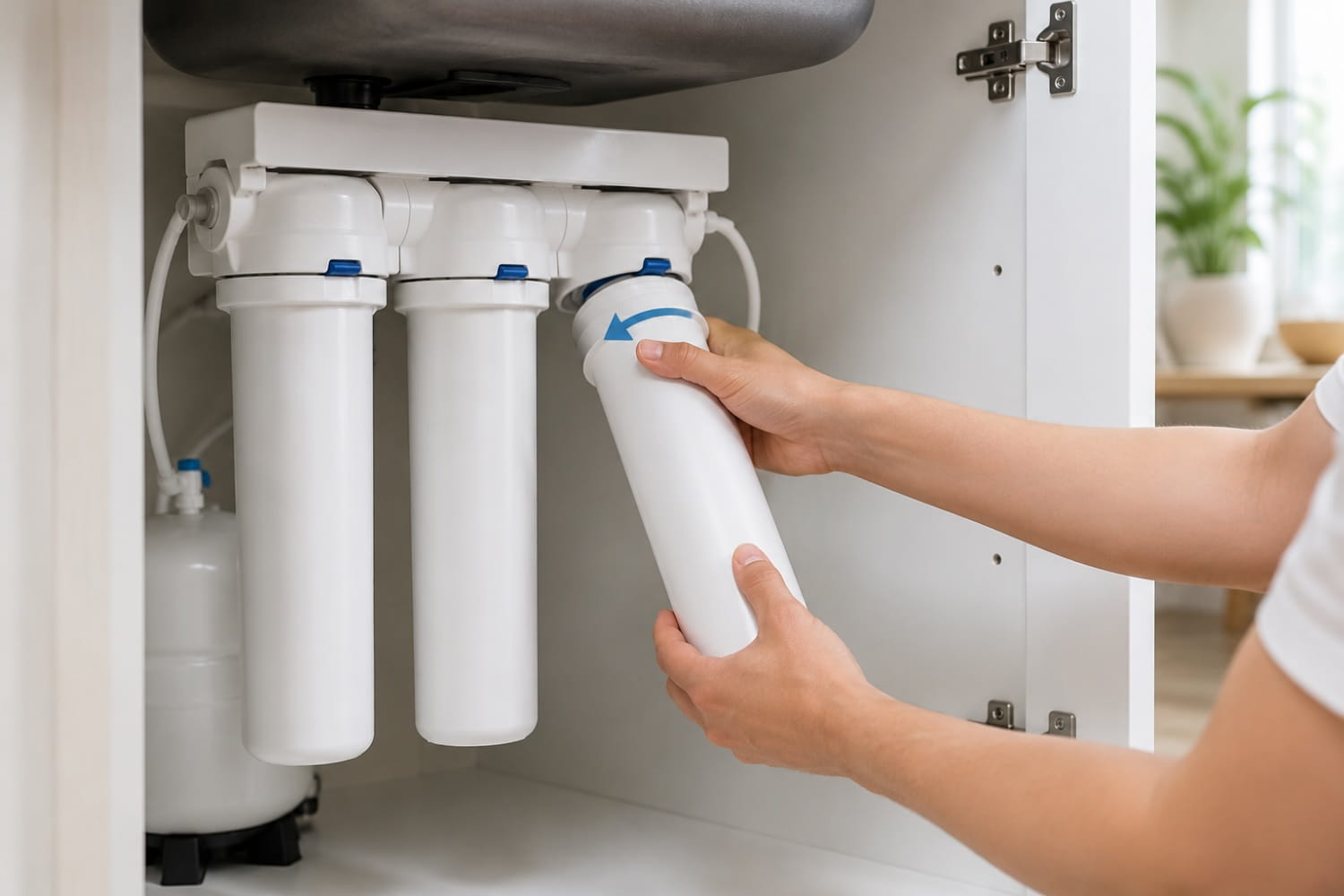
For many homeowners, installing an under-sink Reverse Osmosis (RO) water filtration system is the ultimate step toward achieving pristine, bottled-quality drinking water right at home.
Traditionally, maintaining an RO system was a dreaded, messy chore. It involved shutting off main water valves, using specialized wrench tools to unscrew heavy, water-logged canisters, and occasionally dealing with kitchen-cabinet leaks. It’s no wonder many households resorted to calling a professional plumber—adding an extra $100 to $200 to their annual maintenance costs.
Enter the twist-and-lock water filter design. This innovative technology has revolutionized home water filtration by making the replacement process entirely tool-free and foolproof.
If you are looking to buy a replacement RO filter or considering upgrading to the best under-sink RO system for your home, here is a scientific and practical look at how twist-and-lock technology works, why it eliminates the need for a plumber, and how it keeps your maintenance costs remarkably low.
What is a Twist-and-Lock Water Filter?
To understand why this system is such a game-changer, we must first look at how traditional RO systems are built.
Standard RO systems typically use drop-in cartridge filters housed inside large plastic sumps. Replacing them requires you to use a plastic housing wrench to unscrew the sump, discard the wet filter, clean the slime inside the housing, replace the rubber O-rings, insert the new filter, and tighten it back up perfectly. If the O-ring is slightly misaligned, or if you under- or over-tighten the housing, you risk a slow, destructive leak under your counter.
A twist-and-lock water filter (often referred to as a quick-change water filter cartridge) integrates the filter media and the protective housing into a single, sealed, sanitary capsule.
Instead of opening a housing to access the filter, you replace the entire cartridge. The top of the cartridge features a specialized connector head with integrated double O-rings and locking lugs that align perfectly with the system's manifold.
How It Works
How does a simple "twist" secure a high-pressure water connection without leaking? The secret lies in precise structural engineering:
-
Integrated O-Ring Seals: Twist-and-lock cartridges feature heavy-duty, pre-lubricated radial O-rings built directly onto the cartridge neck. When you insert the filter and twist it, these rings slide into a polished cylindrical chamber in the manifold, creating a tight, hermetic seal that can easily withstand standard household water pressure.
-
Built-in Auto Shut-Off Valves: One of the biggest challenges of traditional filter replacement is managing the water pressure. If you forget to turn off the feedwater valve, water will spray everywhere. Many premium twist-and-lock RO manifolds feature an internal mechanical shut-off valve. When you rotate the filter to unlock it, the internal valve automatically closes, blocking the water inlet. When you twist the new filter in, the valve reopens.
-
Keyed Alignment: The locking mechanisms are engineered with "keyways". The cartridge will only lock into place when aligned perfectly, giving you physical and audible feedback (often a satisfying click) that the installation is complete and secure.
Step-by-Step Guide: DIY RO Filter Replacement in Under 3 Minutes
To demonstrate just how simple this process is, here is the standard procedure for replacing a twist-and-lock RO filter. You won't need a single tool, and you certainly won’t need to pay for a professional plumber.
-
Identify the Filter Due for Replacement: RO filters are replaced on a predictable calendar schedule (typically every 6 to 12 months for sediment and carbon pre-filters, and 2 years for the RO membrane), or when you notice a slight decrease in water flow. Simply check which filter is due on your maintenance timeline.
-
Twist to Unlock: Grab the bottom of the expired cartridge. Rotate it 90 degrees counter-clockwise.
-
Pull Down: Gently pull the cartridge downward to remove it from the manifold. Because of the built-in auto shut-off valve, there will be no major spills (just a few drops of residual water).
-
Insert the New Cartridge: Align the arrow or alignment marks on your new twist-and-lock replacement filter with the slot on the manifold. Push it straight up.
-
Twist to Lock: Rotate the cartridge 90 degrees clockwise until it stops and locks firmly into place.
-
Flush the System: Run the drinking water faucet for a few minutes (as recommended by the manufacturer) to flush out any loose carbon fines from the new filter, and your system is fully optimized and ready to go.
Why Twist-and-Lock is a Smarter Investment
When shopping for the best home water filtration system, it is easy to focus solely on the initial purchase price. However, the cost of ownership over three to five years is where the true value of a system is determined.
Here is how twist-and-lock systems compare to traditional systems across critical consumer metrics:
1. Significant Cost Savings
Since traditional RO systems require filter changes every 6 to 12 months, professional maintenance fees can quickly surpass the cost of the system itself. With a DIY RO filter replacement, your maintenance cost is strictly limited to the price of the replacement water filter cartridges.
2. Unmatched Hygiene and Safety
In traditional systems, the inside of the permanent plastic filter housings is exposed to the air and your hands during every change. If not sanitized properly, bacteria can colonize the housing. Twist-and-lock cartridges are completely sealed. You never touch the wet filter media, and the internal fluid pathway is completely replaced with every new cartridge, ensuring 100% sterile operation.
3. Zero Stress Over Leaks
Because the O-rings are factory-installed on every new cartridge, you never have to worry about old, stretched-out rubber rings causing a slow leak under your sink. The locking mechanism ensures a perfect fit every single time, eliminating human error.
|
Feature |
Traditional Drop-In Systems |
Twist-and-Lock RO Systems |
|
Tools Required |
Housing wrench, bucket, towels |
None (Hand-operated) |
|
Average Replacement Time |
20–30 minutes |
Under 3 minutes |
|
Risk of Leaking |
Moderate (if O-ring misaligns) |
Extremely Low (factory-sealed) |
|
Sanitation Level |
Risk of manual contamination |
100% hygienic & sealed |
|
Plumber Needed? |
Often preferred by users |
Never |
Choosing the Right System for Your Home
If you are currently evaluating your options, look for an RO system that combines high filtration efficiency (such as a multi-stage filtration process that reduces TDS, chlorine, heavy metals, and PFAS) with a user-friendly design.
While twist-and-lock cartridges may have a slightly higher unit price than bulk-packed raw traditional filters, the savings in plumber fees, the time saved, the absolute prevention of water damage, and the peace of mind make it the most cost-effective and stress-free option for the modern home.
Ready to upgrade your home drinking water experience? Browse our collection of easy-to-maintain RO water purifiers and find the perfect, plumber-free solution for your household today.


