

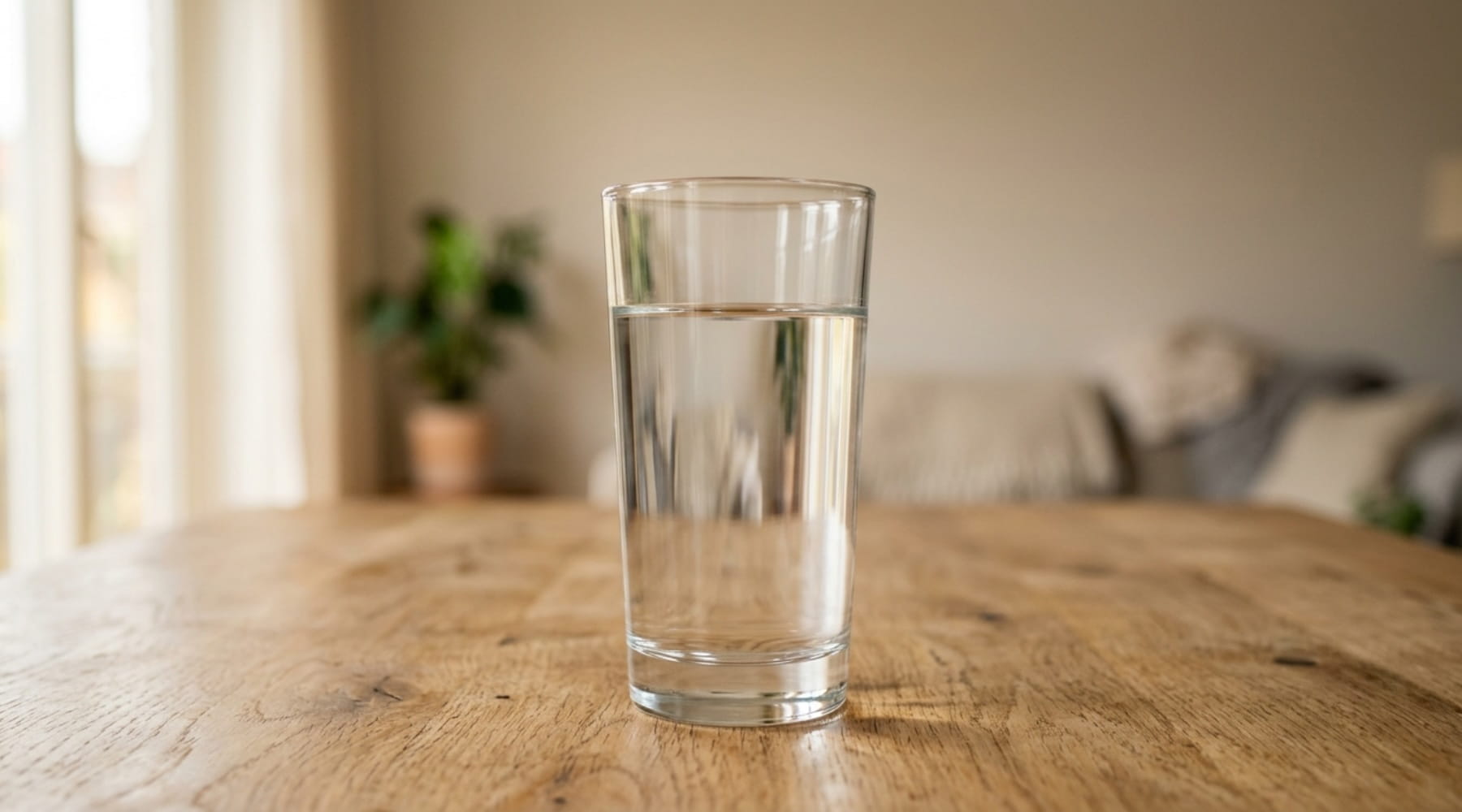
You just finished installing a brand-new reverse osmosis (RO) drinking water system. You turn on the sleek stainless-steel faucet, expecting crystal-clear water, but instead, you get a glass of milky, foggy liquid.
Before you start worrying about faulty equipment or contaminated water, take a deep breath: In over 95% of new installations, cloudy RO water is completely harmless.
This phenomenon is almost always caused by tiny, trapped air bubbles escaping from the system under high pressure. In this blog, we will talk about the facts behind air microbubbles, show you a 60-second home test to confirm your water’s safety, and share simple steps to purge trapped air from your RO lines.
Why Does New RO Water Look Milky?
To understand why air gets trapped in your lines, it helps to look at how a reverse osmosis system operates under high pressure.
When a new system, such as a 5-stage WQA-certified reverse osmosis system is assembled, all the internal components are dry. The filtration cartridges, high-density carbon blocks, microscopic RO membrane pores, and storage tank contain atmospheric air.
When you connect the system to your municipal supply, water rushes in under standard household line pressure (typically 40 to 80 PSI). As water fills the sealed housings, three physical factors come into play:
-
Air Displacement & Degassing: Dry filter media (especially granular activated carbon (GAC) and semi-permeable membranes) contains millions of microscopic air pockets. As water saturates these dry materials, trapped air is forced out into the water line.
-
Pressure and Gas Solubility: Liquid under high pressure can hold significantly more dissolved air than liquid at atmospheric pressure. The pressurized RO tank forces displaced air into a dissolved solution within the purified water.
-
Pressure Relief at the Faucet: When you open the RO faucet, the pressure instantly drops back to 1 atmospheric unit. The excess dissolved air rapidly comes out of solution, forming billions of microscopic air bubbles.
Because these bubbles are extraordinarily small, they scatter light in all directions, making the water appear temporarily white, milky, or cloudy to the naked eye. Dissolved air does not impact water safety, taste, or chemical purity.
Air Bubbles vs. Real Contaminants
How can you be 100% sure the cloudiness is just harmless air microbubbles and not mineral sediment or chemical precipitation? You can perform a simple, 60-second test right on your kitchen counter.
How to do it:
-
Fill a clear glass with water directly from your RO faucet.
-
Set the glass down on a flat surface and watch it closely without moving it.
-
Observe which direction the water clears:
-
Clears from Bottom to Top: If the cloudiness begins dissipating from the bottom of the glass and moves slowly upward, it is 100% air microbubbles. As the bubbles rise to the surface, they escape into the ambient air, leaving crystal-clear water behind.
-
Settles at the Bottom: If particles or cloudiness sink to the bottom over several minutes, you may be dealing with insoluble mineral sediment, scale, or an incorrectly seated filter stage.
Recommended Initial Flushing Procedure
To accelerate the air purging process and condition your new filters, follow this standard flushing routine:
-
Fill the Tank: Let your system’s storage tank fill completely.
-
Drain Completely: Turn on the RO faucet until the stream slows down to a trickle, completely emptying the tank. Discard this initial batch of water (or use it to water plants).
-
Repeat 2–3 Times: Repeat this process two to three times. This flushes out loose carbon fines, saturates the membrane, and removes the bulk of trapped atmospheric air.
What If the Cloudiness Doesn't Go Away?
If your system continues to produce cloudy water after two weeks of continuous use, or if an older system suddenly starts producing foggy water, consider these potential causes:
1. Recent Plumbing Maintenance or Pressure Changes
If municipal roadwork occurred nearby or you recently shut off your main home water valve, sudden changes in water pressure can introduce new air pockets into your home's pipes.
2. Exhausted Filter Media
When pre-filters (sediment and carbon blocks) reach the end of their operational lifespan, they can no longer capture particulate matter effectively. If your RO membrane is degraded or improperly seated, dissolved solids (TDS) can bypass the membrane barrier.
Maintenance Rule of Thumb: Pre-filters should generally be replaced every 6 to 12 months, while the primary RO membrane typically lasts 2 to 3 years depending on feed water quality.
Long-Term Pure Water: The FilterUnited VIVA21 Advantage
Choosing a reliable, well-engineered reverse osmosis system minimizes setup hassles and ensures long-term operational performance. At FilterUnited, our flagship VIVA21 series is engineered with precision tolerances and certified components designed for seamless air bleeding and exceptional water purity.
Whether you are looking for ultra-pure water or health-conscious mineral balance, the VIVA21 lineup delivers:
-
FilterUnited VIVA21 5-Stage WQA-Certified Reverse Osmosis System: Designed for maximum purification efficiency, removing up to 99% of heavy metals, chlorine, fluoride, microplastics, and dissolved solids. Certified against strict WQA ANSI/NSF standards for material safety and structural integrity.
-
FilterUnited VIVA21 6-Stage Remineralization Reverse Osmosis System: For those who prefer a natural, balanced taste. After deep 5-stage purification, the 6th remineralization stage adds essential alkaline minerals like calcium and magnesium back into your drinking water, restoring a smooth, clean taste and balanced pH.
Summary Checklist
|
Symptom |
Cause |
Solution |
|
Water clears from bottom to top in 1–2 min |
Harmless dissolved air microbubbles |
Normal for new installations. Flush tank 2–3 times; clears in 1–2 weeks. |
|
Water remains cloudy or sediment settles at bottom |
Particulates or membrane bypass |
Check filter installation or replace with a new VIVA21 Complete Filter Set. |
|
Cloudy water appears in an older RO unit |
Exhausted pre-filters or municipal pressure surge |
Replace the Pre-Filter Set and inspect the system for leaks or air leaks in tubing fittings. |
Final Thoughts
Cloudy RO water after a new system setup can look alarming, but in almost every instance, it is simply physics at work. Once the trapped air microbubbles escape your new filters, you will enjoy pure, refreshing, crystal-clear drinking water every time you turn on the tap.
Ready to upgrade your home drinking water or due for a routine filter replacement? Explore FilterUnited’s VIVA21 Series, high-performance Complete Filter Sets, and genuine accessories to experience clean, pure hydration designed for your family.


